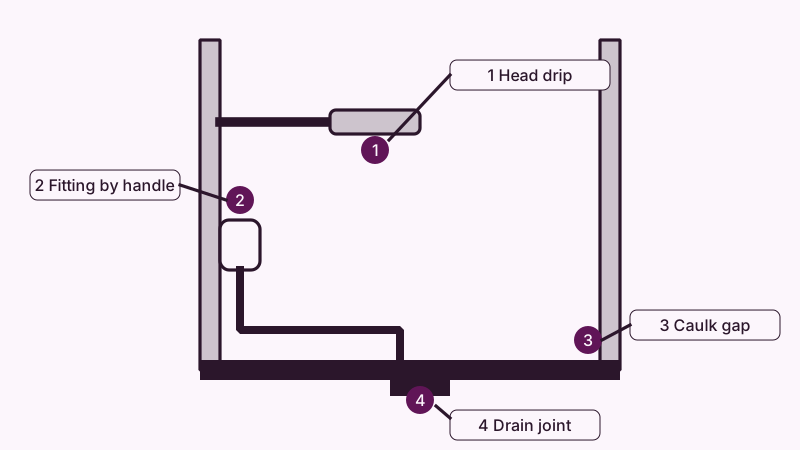
Dripping from the showerhead or spout is a fixture fault, most often a tired cartridge or washer. A wet bathroom floor, a brown mark on the room beneath, or a clammy wall implicates the pan, the drain or an in-wall pipe. This article belongs with our fixture pages, starting from garbage disposal and fixture repair in Torrance, and helps you sort the cases before you call.
Which part of the shower is the culprit?
Note where water turns up, and at what moment. A drip when the shower is off comes from the valve, cartridge or head. Water that shows only with the shower running implicates the arm, the pan, the door seal or the drain. Staining on an adjoining wall or the ceiling below can mean a supply pipe, or a pan that no longer holds.
A quick sorting:
- Dripping from head or spout while off. A tired cartridge, washer or seat, or a diverter that has stopped sealing.
- Leaking at the wall behind the handle or spout. A loose or poorly sealed fitting, or a connection behind the wall.
- Water outside the shower when it runs. Failed caulk or grout, a gap at the door, or a pan or liner that no longer holds water.
- A damp wall, floor or ceiling nearby, with no obvious source. A supply or drain line may be leaking inside the wall.
- Water that sprays or runs when nothing is on. A burst or split pipe. Shut off the water.
Tubs and showers sit on drains and traps that can also leak. Two simple tests help: tape paper over the suspected area and see if it gets wet while the shower runs, and run water with the drain plugged to see whether the leak depends on the drain.
What if a shower pipe has burst or water is pouring from the wall?
Get the house main closed immediately, and let the lines empty through a low faucet. Stay out of a room if water has touched a socket or ceiling light, and switch the breaker off only while standing on a dry floor at the panel. Then phone a plumber. Do not use the shower or the line again until it is repaired.
A burst pipe behind a shower usually shows as sudden flow, a hissing sound, water staining through drywall, or wet floors with the shower off. Tile and tub surrounds hide the damage, so the plumber may cut into the wall or go in from the other side through an access panel. Fixr's guide puts shower pipe repair at $200 to $600 and a leak behind a shower wall at $200 to $1,000, and tile and drywall repair come extra. Spotting a burst pipe lists the signs, and leaking pipe repairs describes the fix.
Wet drywall deserves quick attention. The Wikipedia overview of water damage says mold can begin within 24 to 48 hours in damp materials and recommends drying wet areas within 24 hours.
How much does shower leak repair cost?
Fixr's national guide puts shower repairs at $100 to $700, averaging about $350. A leaky faucet or fixture repair runs $150 to $350, a diverter repair $75 to $200, and unclogging a shower drain $100 to $300. These are national guides, not Torrance quotes.
| Problem | National guide figure |
|---|---|
| Shower repair, typical spread | about $100 to $700 |
| Leak behind a shower wall | about $200 to $1,000 |
| Leaky faucet or fixture | about $150 to $350 |
| Diverter repair | about $75 to $200 |
| Unclogging a shower drain | about $100 to $300 |
| Shower pipe repair | about $200 to $600 |
| Pressure-reducing valve | ask for a written quote |
What drives the cost: whether the plumber can reach the valve from the front or must open the wall, the type of valve and cartridge (older valves may need a full replacement), the tile and finish repair afterward, and any permit. Water damage repair is separate. For a fixture swap on existing connections, a permit is generally not an issue, but Torrance says plumbing permits cover pipes and fixtures and are applied for online through Building and Safety; ask before opening pipes.
The tub is weak but every other tap is strong. Why?
When just the tub or shower is feeble, suspect a scaled head or spout, a diverter misdirecting flow, a seized cartridge, or a stop valve that was left half shut. Fixture-level causes fit best, because a house-wide pressure problem would show up everywhere. Start by removing and cleaning the showerhead.
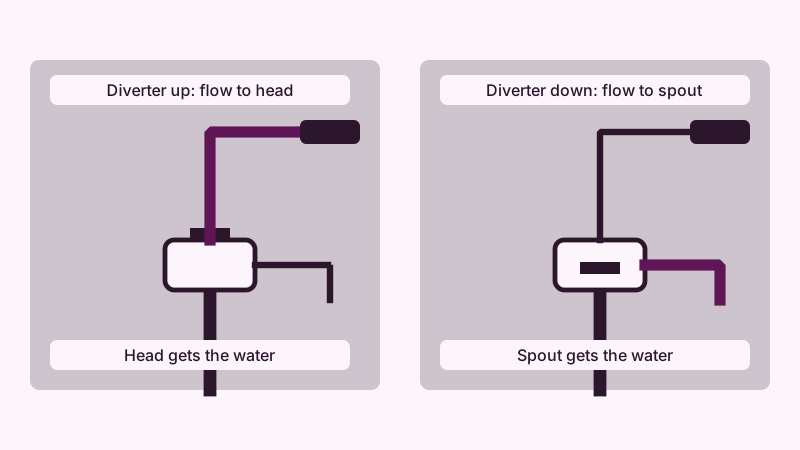
Try this order: soak the showerhead in vinegar to clear scale, check that the tub spout diverter lifts fully, and look at the cartridge or valve stem. If hot only is weak, see low hot water pressure. If the whole bathroom is weak, check the angle stops, and read shower water pressure for a longer walkthrough. A leaking diverter can also drip from the head after the shower is shut off, which mixes the two symptoms.
Is a dripping shower worth fixing?
Yes. EPA's WaterSense program gives two numbers. A showerhead dripping ten times per minute wastes 500-plus gallons annually, and the average household leak total passes 9,300 gallons. A drip also stains fixtures and can mean a worn part that will fail completely, so repair is cheap insurance.
Dripping from the handle or spout can be a weekend project. Turn off the water, remove handle and trim, withdraw the cartridge, and bring it to a plumbing supply store for an exact match. Take the old part with you. Valve-body corrosion, stops that fail to hold, or a leak in the wall cavity are professional territory. Our walkthrough on fixing a leaky faucet in a shower covers the DIY steps, and tub faucet leaks covers the tub version.
What about sink and disposal searches that landed here?
Some readers arrive here looking for garbage disposal installation, whether an InSinkErator Badger 500, an American Standard or a Glacier Bay, or for mobile home sink plumbing. Those are fixture jobs, not shower leaks. The installation steps follow the manufacturer's instructions, which come with the unit, and local pricing is in the plumber faucet and disposal cost guide.
For a disposal, the usual job is mounting the unit under the sink flange, connecting the drain and the dishwasher line, and wiring or plugging it in. Wiring should be done by someone qualified. For a mobile home sink, supply lines and traps are often smaller and plastic, and access is tight, so a plumber who has done it before saves time. We arrange local plumbers in Torrance and the South Bay for these as well; ask for the job you need on the quote page.
Common questions
For how long will the shower be unusable?
A cartridge or washer change fills an hour or two. A valve replacement, an access hole in the wall or a pan repair takes longer, and tile or drywall finishing is a separate step that may need another day to cure. Ask for a schedule that covers the plumbing, drying and surface repair.
Which details belong on a shower-leak quote?
The contractor license number, the way the leak will be found, whether the wall gets opened, who repairs tile and drywall, and what the visit costs. Also ask whether a permit applies. All of it should be written on the quote before any work starts.
Should someone be at home for the repair?
Yes: someone to point out which shower leaks and when, unlock access to the bathroom and shutoffs, and check the finished work. The shower will be out of use for a while. Tell the plumber about any stains on the ceiling below and clear the bathroom.
Can a shower leak damage the floor below?
Yes. Water from a failed pan, drain or pipe can soak the subfloor and the ceiling beneath, and can cause mold and rot over time. If you see a stain below a bathroom, stop using the shower and have the source found. A slow leak is easier and cheaper to fix before the structure is wet.
Should I use the shower while waiting for a plumber?
If the leak is only a drip when the water is off, you can keep using the shower while you wait, if it is not staining anything. Stop using it, and close the water, if liquid is getting outside the shower, a wall or ceiling is wet, or a pipe has split. A short wait costs less than damage.
The rest of our guides start from plumber torrance.
Sources used
Last updated