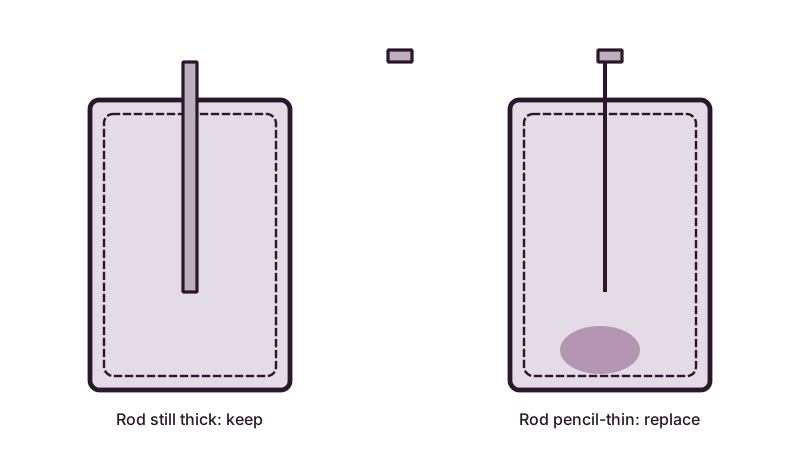
A glass-lined tank heater has a metal rod hanging inside it that is built to corrode ahead of the steel. After it is spent, the shell starts rusting and a leak comes next. Bob Vila advises replacing it about every 3 to 5 years, and a plumber typically charges $200 to $300 for the job. The bigger question of fixing or replacing the heater sits with water heater repair in Torrance; this page is about the rod alone.
Why is there a rod in my tank at all?
It is a sacrificial metal, usually magnesium or aluminum, threaded into the tank top and dangling in the water. Corrosion goes for the rod in preference to the steel, so the rod wears away while the shell lasts. When only the core wire is left, the tank is next in line.
Think of it as a fuse for rust. The rod is cheap and the tank is not, so the arrangement is a bargain until somebody forgets about it. Many owners never check one over the whole life of a heater. A tank with its rod intact at year ten has a good chance of reaching the upper end of its expected life, a lifespan Rheem puts between 8 and 12 years and the Department of Energy guide at 10 to 15. Tankless heaters have no tank and no rod, so none of this applies to them.
How often should the rod be replaced in Torrance?
Plan on every 3 to 5 years, and lean toward the short end for hard or mineral-heavy water. A mineral-rich supply eats a rod faster. Torrance's 2025 water quality report shows about 696 ppm dissolved solids in its groundwater and about 541 ppm in imported supply, so a check at 3 years makes sense.
Published guides give a wide spread, with some saying a magnesium rod in very hard water can be down to bare wire in 2 to 3 years and an aluminum rod can last longer. Rather than rely on a calendar, pull the rod and look. Bob Vila says a rod that is still thick and covered in only a little scale has life left and can go back in. A rod that is pencil-thin, or coated in chalky buildup so that the core shows, is finished. If you have never touched yours and the heater is past 6 years, an inspection is overdue.
What will a plumber ask to swap the rod?
Bob Vila gives a plumber's price as roughly $200 to $300; other published guides stretch from $150 to $400. Parts account for $20 to $50, and labor plus the visit fee make up the balance. A rod that has seized in the tank, or a heater tucked under a low ceiling, pushes the bill higher.
| Item | Guide figure |
|---|---|
| Rod only, magnesium | roughly $20 to $40 |
| Rod only, aluminum or aluminum-zinc | roughly $25 to $50 |
| Plumber replacement | about $200 to $300 (Bob Vila) |
| Seized rod or tight clearance | can climb toward $400 to $700 |
| Do-it-yourself, parts and a rented tool | about $30 to $90 |
These are guides, not a quote. The same visit is a good moment to flush sediment, test the relief valve and look over the strapping, and ask the plumber to price those together. The relief valve is covered in replacing a pressure relief valve.
Which kind of rod should I choose?
Magnesium is the general-purpose choice and protects best. Aluminum suits very soft or low-pH water, where magnesium disappears quickly. An aluminum rod with a little zinc is sold to reduce the rotten-egg smell some tanks develop. Your heater's manual, or the plumber, can say which suits your water.
Where there is little headroom above the tank, a flexible, segmented rod can be bent in place of a rigid one. A powered anode, driven by a trickle of current and never consumed, is a separate product; guides quote it from $150 to $500 installed. Be aware that the sales claim of a longer tank life is the maker's, and not every dealer's warranty accepts a swap. Ask before you buy.
Is the sulfur smell from my hot water a gas leak?
Not necessarily, and the difference matters. A rotten-egg smell at the hot tap only, and not near the heater or the meter, is more likely bacteria reacting with the rod. A gas leak smells similar because gas is odorized, so do not guess: if you smell it near the heater, the meter or inside, treat it as gas.
If gas could be the cause, leave without touching switches, phone SoCalGas, 1-800-427-2200, from a safe spot outdoors, and add 911 when there is danger. Never try to trace a gas smell yourself. If the smell appears only when you run hot water, a change of rod type or a tank flush often fixes it, and a plumber can help. SoCalGas explains the warning signs on its leak safety page.
Can I replace the rod myself?
Many handy owners do. You need a socket or wrench to fit the hex head, a breaker bar if the rod is stuck, thread tape, a hose to drain a few gallons, and about an hour. Bob Vila rates it intermediate and warns against striking the tank, since the glass lining can crack.
Begin by closing the cold valve above the tank and cutting power: breaker off for electric, gas dial to pilot or off for gas. The usual snag is a stuck rod. If a breaker bar will not shift it, put the tools down and book a plumber instead of forcing it. Do not touch gas piping at all. After the swap, check the connection for drips for a day. A wider maintenance checklist appears in replacement timing for water heaters.
When is it too late for a new anode rod?
A tank that already weeps at a seam or the base is beyond help from a new rod, because the steel is breached and replacing the heater is the repair. The same goes for a tank well beyond its expected life, or one that rumbles with heavy sediment. Compare costs before spending anything.
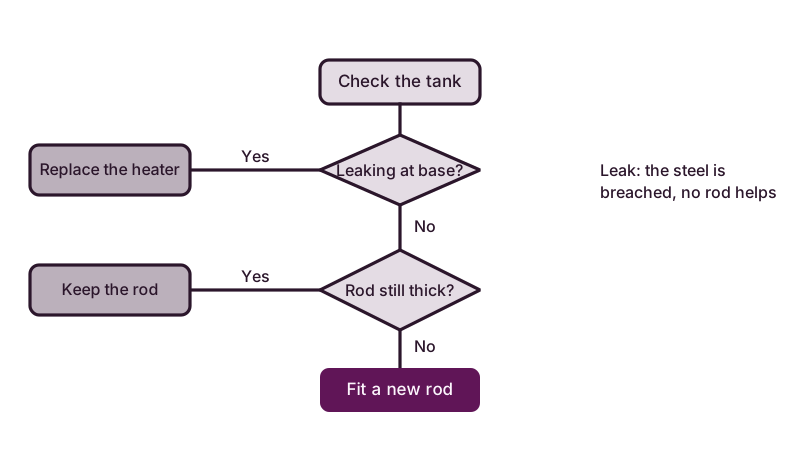
A rod swap is for a healthy tank that has no leak. Check the floor and the base of the heater for moisture and rust streaks. Spot water and the next reads are leaking water heaters and what a new heater costs. For a written price from someone local, use the quote form.
Common questions
Does every water heater have an anode rod?
Every glass-lined tank heater does, and some have two. Tankless heaters do not, because they have no tank to protect. A few tanks have a rod combined with the hot outlet nipple, which can make it harder to find. The model's manual shows where it sits.
What if the rod is never touched?
The rod eventually runs out, and the tank starts corroding from inside. Bob Vila says a tank with no maintenance could rust out in under 10 years, while a maintained one can last 15 to 20. A new rod is no promise of that outcome, but it removes the cheapest cause of early failure.
Will a new rod void my warranty?
It should not, if you use the correct rod and fit it properly, but check the maker's terms. Some warranties expect annual maintenance, and some dislike non-standard rods or powered anodes. Keep the receipt and a note of the date, and ask the plumber to write down what was done.
Can a plumber replace it during a flush?
Yes, and it is the sensible time. The tank is partly drained and the plumber is already at the heater. Request a flush, a rod inspection, and checks of the relief valve and strapping in one visit, with each line priced separately.
How can I tell a spent rod?
Remove it and look. Bare core wire, a rod much thinner than new, or chunks missing mean it is spent. One that is still thick with only a little scale can go back in. There is no reliable way to judge it from outside the tank, other than age.
For the wider picture, start with plumber across Torrance.
Sources used
- Bob Vila, anode rod replacement, checked November 2026
- Published anode rod price guides, checked November 2026
- Rheem, water heater lifespan and when to repair or replace
- U.S. Department of Energy, Energy Saver guide (tank life, 120 F setting)
- SoCalGas, natural gas leaks
- City of Torrance, 2025 annual water quality report
Last updated