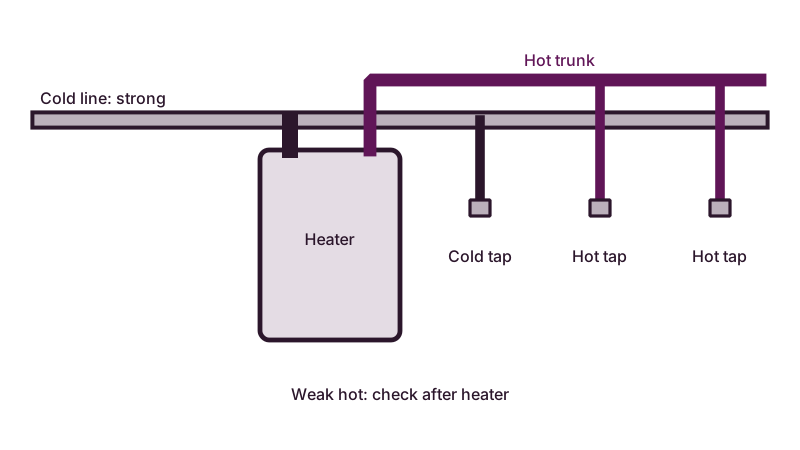
Run the cold faucet over the dishes, then the hot. One roars and the other sputters? Good news of a sort: the city supply is healthy, so whatever is choking the flow lives downstream of the cold line's branch to the heater, in the tank, its fittings, or the hot pipes. The checks below start with the cheapest and end with the ones that need a trade. The wider topic is water heater repair in Torrance.
What makes only the hot side weak?
Something restricts flow after the water enters the heater: a half-open shutoff valve, sediment plugging an outlet fitting, scale in a faucet, or corroded hot pipe. The location of the weakness narrows it. One tap points at that fixture; every hot faucet points at the heater or the hot trunk line; a flow that starts well and fades points at sediment or a tankless limit.
Read the pattern:
- One tap only. The aerator, showerhead or cartridge is clogged with scale.
- All hot taps. Heater outlet, valve, dip tube or the hot trunk.
- Strong, then fading. Sediment flaking loose, or a tankless unit hitting its flow ceiling.
- Hot and cold both poor. Not a hot-water problem. See low water pressure through the whole house.
Could scale at one faucet be the whole story?
Often. Mineral crust narrows aerators, showerheads and cartridges, and hot water deposits scale faster than cold. Unscrew the aerator, soak it an hour in a mug of white vinegar, rinse, then judge the stream. A shower alone being weak may point to its cartridge or diverter instead.
Hardness matters locally. Cal Water's 2025 report for the Hermosa-Redondo system lists groundwater averaging about 502 ppm total hardness, in the report's "very hard" band of 300 ppm and above, and says hardness can leave mineral buildup in plumbing. Other South Bay supplies differ by street, so scale is plausible in your house, though not certain.
A bucket test settles whether the fixture is to blame: time how long hot and cold take to fill the same bucket. A big gap at one tap, but not at others, indicts that fixture. Also glance at the braided hoses under the sink for kinks and at the stop valves for a half-turned handle. Showers get their own page: low shower pressure covers heads, cartridges and diverters.
Is the water heater itself choking the flow?
When every hot faucet is poor, the heater is next on the list. The valves on its top should be fully open, sediment may be plugging the outlet fitting or a mixing valve, and a tankless unit may be scaled or running into its flow ceiling. Rumbling from the tank hints at sediment. A valve reopened only halfway after a repair is a classic culprit.
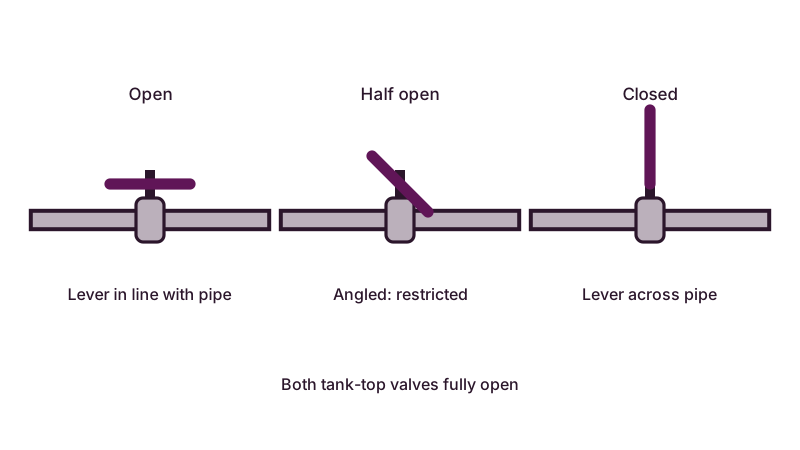
A tank heater has a cold inlet and hot outlet on top, each with a shutoff. Lever handles should line up with the pipe; round handles should be fully counterclockwise. Flushing sediment is normal upkeep, described in repairing water heater leakage.
Tankless units limit flow by nature. Commonly quoted energy guidance gives them roughly 2 to 5 gallons a minute. With three appliances drawing at once, the thin stream you notice is the heater's flow ceiling rather than a pressure fault. Scale inside the heat exchanger makes things worse, so descaling is routine on hard water. Error codes call for a plumber; Navien tankless repair discusses one popular brand.
Do old pipes explain it in a Torrance house?
They might. A lot of South Bay housing dates from the postwar decades, and homes of that age may keep their original galvanized steel water lines, rusting inwards and gradually closing up. Hot lines often suffer first, because heat speeds corrosion and scale. If every hot tap is poor, cold is fine, and the house is old, a plumber may suggest a repipe.
Galvanized pipe looks gray, has threaded joints, and attracts a magnet; copper does not. Brown tint in the first draw of the day also fits. A short section can occasionally be swapped, but widespread corrosion usually means repiping. Our pages on galvanized pipe replacement, PEX versus copper and repiping a house cover the choices.
Could a regulator or a hidden leak be involved?
A failing pressure regulator usually weakens both hot and cold, so it rarely explains hot-only symptoms. A leak on the hot line can, above all a buried one in a slab or wall cavity. Tell-tales: floor that feels warm, hissing, damp drywall, or a meter dial moving while everything is off.
EPA's WaterSense program recommends this check: write the meter reading down, leave the house dry for two hours, read it once more. A different number points to a leak. Plumbing codes generally expect a regulator once supply pressure climbs past about 80 psi, and the pressure regulator adjustment guide describes the device. A hidden leak is a job for plumbers for leaks.
What can I handle, and what belongs to a trade?
You can clean aerators and showerheads, open heater valves fully and drain some sediment. Everything else is a plumber's: a gas heater that stays dark, tankless error codes, a water heater replacement (Torrance needs a plumbing permit), suspected leaks in walls or slabs, galvanized pipe, and any gas line or vent work.
Costs hinge on the cause. Cleaning a fixture is free or close to it. A pressure-reducing valve, when that is the fix, is priced on the written quote. A repipe is a bigger project, and a replacement heater costs hundreds to low thousands nationally; water heater replacement cost has the guide figures. A plumber quotes once the cause is found, and the quote page starts the process.
If only the washer runs cold, read the washing machine no hot water guide.
Common questions
How long does the diagnosis take?
Ruling a fixture in or out takes minutes; a valve check or flush at the heater, under an hour; proving a leak or corroded run, longer. Name the weak taps in your request so the plumber starts at the right spot.
What should be settled before work starts?
Get the plumber's contractor license number, a description of how the cause gets found before any fix is priced, a statement on whether the call-out fee is netted off the repair, and a plan for a heater or pipe that turns out to need replacing. Distrust a new-heater pitch made before valves and fixtures were checked.
Do I have to stay in?
Better to. You can describe the symptoms, show the heater and its valves, and test the hot taps afterward. Leave the heater closet and the sink cabinets clear. If you cannot, send photos and have a trusted adult open the door.
Why does the pressure drop only after the heater has been running?
Sediment or scale partly blocks the heater's outlet or a tankless heat exchanger, so flow falls once the unit is working. A tankless unit also limits flow when several fixtures run together. Flushing, descaling or a larger unit tends to cure it, and a sudden onset deserves a look at valves and the gas supply.
Can weak hot water hurt anything?
The weakness itself does not, but its cause can. Scale and sediment shorten heater life, corroded pipe can eventually leak, and a stuck valve can overheat a tank. Treat a sudden change as something to diagnose, and read about maintaining a water heater.
This guide is one of many on Del Amo Plumbing plumber.
Sources used
Last updated