Lukewarm showers, scalding taps, or water that runs out after five minutes can all trace back to a worn thermostat on an electric tank. Most electric heaters carry two, one beside each heating element, and each costs less than a restaurant dinner. Before replacing anything, confirm the thermostat is the culprit, because an element or breaker can look the same. Our overview of water heater repair shows the other usual faults.
What do the two thermostats actually do?
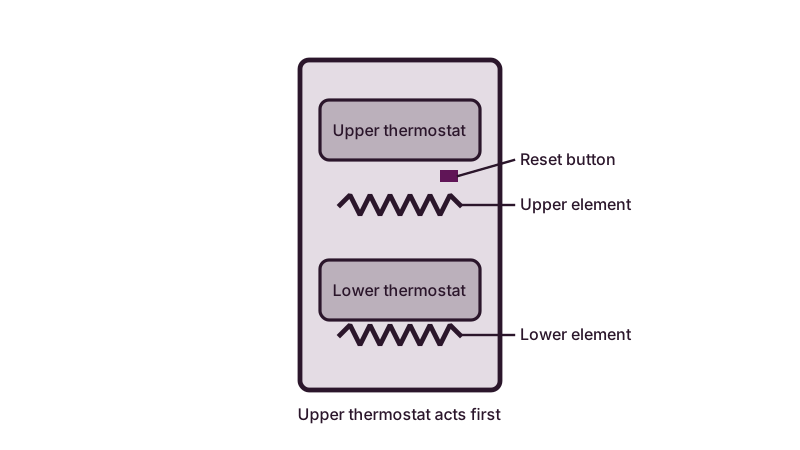
The upper thermostat acts first. It sends power to the upper element until the top of the tank is hot, then hands control to the lower thermostat, which heats the bottom. The upper one also carries a high-limit safety switch with a red reset button that trips if the water gets dangerously hot.
That handoff matters for diagnosis. A brief rush of hot water followed by cold points down the tank, to the lower element or its thermostat. Nothing hot at all points up: the upper thermostat, the high-limit switch or the breaker. Scalding output suggests a thermostat welded shut, and that is a hazard.
Tankless electric heaters have no tank thermostat like this. Their temperature control sits on a circuit board, and a different repair path applies.
Which symptoms point to a bad thermostat?
Suspect a thermostat when water runs hotter than the dial, stays lukewarm whatever you set, takes forever to recover, or keeps tripping the red reset button. Rumbling noises and rust-colored water usually mean sediment or tank wear instead. Rumbling sounds and rust-colored water are more often sediment or the tank itself.
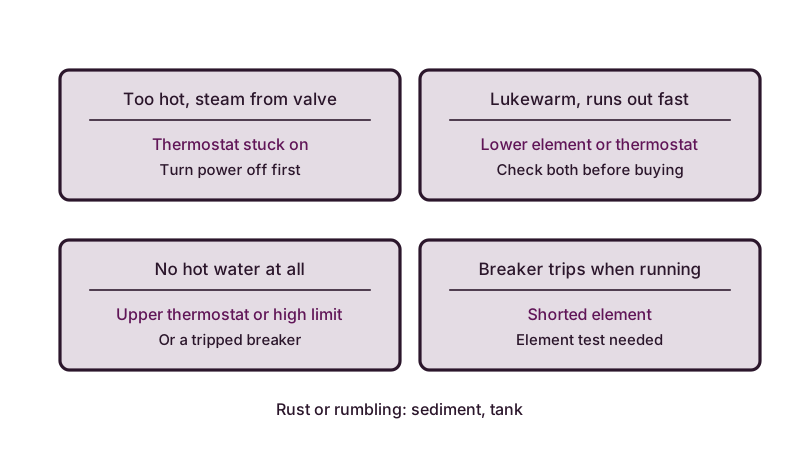
Compare these before buying parts:
- Too hot, steam from the relief valve. Probably a thermostat stuck on. Kill the breaker and book service.
- Lukewarm, and gone within minutes. Lower element, lower thermostat, or a failed dip tube.
- No hot water at all. Tripped high-limit, bad upper thermostat, or a tripped breaker. Press the reset button once, after the power is off.
- Breaker trips whenever the heater runs. A shorted element. See replacement water heater element.
- Wet insulation or puddles. A leak, and that is a different problem. See water heater leak.
When the whole heater has gone cold, the wider checklist in no hot water at home applies.
How do you test a thermostat safely?
Flip the breaker, then confirm no voltage remains using a non-contact tester before touching metal. Take off the panel and insulation, check every terminal for voltage, then test the thermostat for continuity with a multimeter. Meter readings on a thermostat only mean something with the power off.
This is a 240-volt appliance. Mistakes can be serious. If you are not comfortable with a multimeter and a panel breaker, hire a plumber or an electrician. Replacing a thermostat is a component swap, but any rewiring or work on the supply circuit is electrician territory.
Many people stop at the breaker and reset the high-limit once. If it trips again within a day, something is wrong, and resetting repeatedly only hides it.
How does a thermostat get replaced?
With power confirmed dead, lift the cover, tag the wires, and unclip the old thermostat. Press the new one flat against the tank wall, reconnect the tagged wires, set the dial, then replace insulation and cover. Power comes back only once the tank is full.
Power to an element sitting in air destroys it within moments. Open a hot tap and wait for a steady stream before you flip the breaker back.
Buy the part that fits your model. Upper and lower thermostats are different parts, and fitting sizes vary. With an old heater, replacing both makes sense because they age together.
What temperature should it be set to?
Around 120 degrees Fahrenheit is the commonly recommended household setting, a compromise between scalding and comfort. Much hotter water can burn skin in seconds, a particular danger for toddlers and the elderly. Set both thermostats alike, or the lower a touch under the upper.
Whatever the setting, keep the high-limit switch working. A thermostat that fails to shut off at its set point deserves replacement right away.
What does it cost?
Plumbers' prices in published guides run from roughly $100 up to $350 once parts and labor are added, most between $150 and $300. Parts are about $15 to $50, so most of the bill is the visit itself. Swapping it yourself costs about the price of the part.
| What you pay for | Guide figure |
|---|---|
| Thermostat part | About $15 to $50 |
| Plumber visit with part fitted | About $100 to $350 |
| Doing both thermostats at once | Adds roughly $15 to $40 in parts |
These are guide numbers; your final price is the one on the written quote. If the tank is 8 to 12 years old, ask whether replacing the heater makes more sense; electric heater replacement costs helps you compare.
Does a thermostat swap need a permit in Torrance?
Torrance lists water heaters under its plumbing permit. A thermostat swap is a repair of one component, and we found no published rule requiring a permit for it. A whole-heater replacement is different, and the article on water heater permits covers it.
Common questions
How long does the plumber stay?
Around an hour when the heater is easy to reach. Add time if the insulation is soaked, wires are corroded, or both thermostats and an element are being changed. Doing it yourself for the first time takes longer, and the careful power check is not a step to skip.
What should be settled before booking?
Ask whether both thermostats are included, whether the elements get tested, what the visit fee is, and what happens if the tank itself is failing. Ask how old the heater is, too, because a plumber should tell you honestly when repair makes less sense than a new tank.
Who needs to be home for the repair?
Yes, an adult. That person admits the plumber, points to the heater and the breaker panel, and agrees the price, which takes only a few minutes. Keep the space around the tank free, and plan on the power being off for a stretch.
Why does my water get too hot even after the replacement?
The new thermostat may be set too high, the wrong part may be installed, or the lower thermostat may still be faulty. Turn the power off and have it checked. Water that runs too hot is a scald risk, so do not leave it.
Can the thermostat fail while the element still works?
Yes, because the two parts fail on their own schedules. A thermostat can stick open or closed while the element tests normally, and the reverse also happens. Testing both before buying parts saves money and a second trip, and a plumber carries a meter for exactly this check.
For the wider picture, start with Torrance plumber.
Sources used
- Published price guides for electric water heater thermostat replacement, checked November 2026
- City of Torrance, Building and Safety FAQ
Last updated