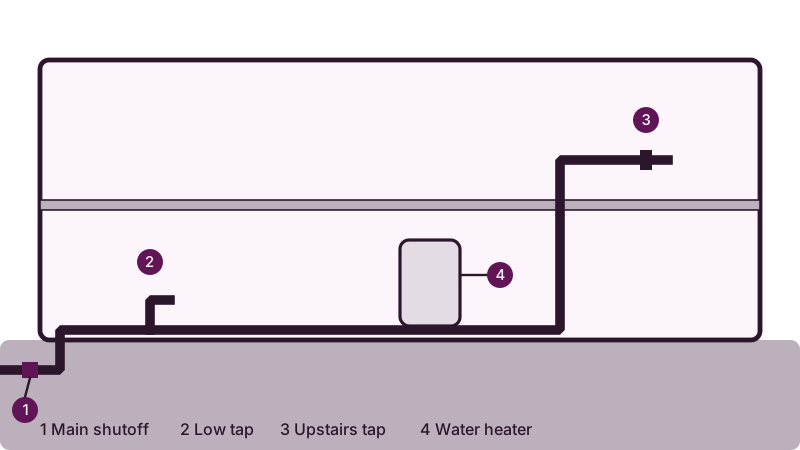
Closing the valve is your job, not a plumber's, and it takes seconds if you already know where the valve is. Everything afterward belongs to the trades: tracing the failure, cutting out the weak section, fitting new pipe, testing. If what you have is a slower weep rather than a true burst, the leak plumber hub sorts the other situations.
What comes first when the pipe lets go?
Your first move is the house shutoff. Most Torrance homes keep it close to where the pipe comes up out of the ground, or in a small meter-side box. Turn it off, drain the line by opening a spigot at ground level, and kill breakers to soaked rooms only when the panel is out of the water. Then carry valuables out.
Written as a short drill:
- The main. A round gate-valve handle needs several clockwise turns; a lever-style ball valve turns a quarter. A valve that fights you is worth noting for later.
- Relief. Opening a downstairs tap and an upstairs one lets gravity empty the pipework, and one toilet flush clears the tank.
- Power. Wet rooms lose their breakers. A soaked panel or a flooded floor around it means you walk away and call 911 or the fire department.
- Water heater. If the heater is in the splash zone, cut its gas or power so it cannot fire on a half-empty tank.
- Evidence. Photograph the scene before mopping, since an insurer will want it.
The valve at the curb meter belongs to the water provider; ask before turning it. Locate your own main today and exercise it once a year, because a valve left untouched for decades can seize exactly when you need it.
Is it a burst or only a leak?
Bursts announce themselves with a roar or hiss behind a wall, a sagging ceiling, water sheeting down a surface, or a meter dial racing while every tap is shut. Leaks creep. They leave a ring on the ceiling, a damp cabinet floor or a slowly growing stain. EPA's meter check settles doubtful cases: record the reading, wait two hours, look again.
Concealed failures leave different clues: a warm damp patch in a slab floor, a hiss inside the wall, pressure that suddenly sags, or a bill that leaps. More warning signs appear on the page about recognizing a burst pipe, and why the water bill climbs shows how Torrance's tiers make the cost land quickly.
What makes pipes fail around Torrance?
Mostly from age, corrosion and pressure, with frost a distant fourth. Galvanized steel corrodes from within, old copper thins until a pinhole opens, and joints give way first. Add stress from a regulator that no longer regulates, or from a valve that slams shut. Earthquakes shear rigid pipe too. A hard freeze is rare in Torrance, though not impossible.
Tract homes from the postwar boom in Torrance, Gardena and Lawndale were frequently plumbed in galvanized steel or copper, and those lines are now old enough for failures to bunch up. Torrance publishes a water pressure map on its customer information page, and pressure differs between zones. Static pressure shows up on a dial screwed to a hose connection, so a plumber can tell in minutes whether the regulator has quit.
For more: what makes a pipe burst goes deeper, and galvanized pipe replacement explains why some houses are repiped rather than patched.
What does the repair itself look like?
The plumber finds the break, saws out the failed section, joins in new pipe, and pressurizes the line to prove it holds before any wall is closed. When the old pipe is brittle, another failure often follows a few feet along, so you may be offered a longer replacement or a repipe. Wall and floor finishing come afterward.
Scope depends on a handful of things:
- Reach. Crawl-space pipe is easy to touch; pipe inside a finished wall demands an opening, then patching.
- Pipe type. Each of copper, galvanized steel, PEX and CPVC repairs differently, and mixing metals calls for the right transition fittings.
- Slab. Under a foundation the options include tunneling or rerouting the line overhead.
- Cause. If excessive pressure did it, a new regulator is part of the cure.
Bigger changes can trigger a permit; ask Torrance's Building and Safety Division. Smaller failures are covered under leaking water pipe repair.
How do I get the house dry again?
Start by getting the pooled water out, by pump if the volume is large. Then bring in moving air: box fans aimed along the floor and a dehumidifier in the closed room, with baseboards popped and cabinet kickplates removed. EPA's mold advice boils down to quick repair and total drying; carpet and ceiling tile that grow mold are often beyond saving.
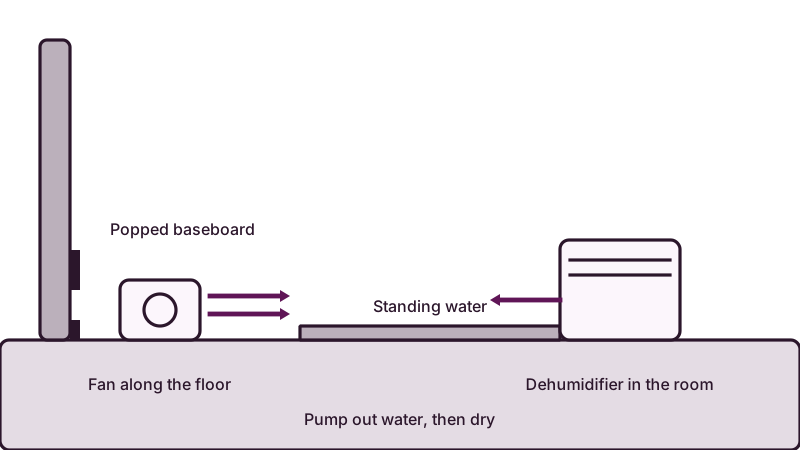
Surface dryness fools people: wet insulation and drywall stay damp inside for a long while. Past about a ten-square-foot patch of mold, EPA points toward professionals, as it does for extensive soaking. Where the water came through a ceiling, the ceiling damage page explains what to cut out.
Before any repair work, read up on insurance and burst pipes, since coverage often turns on sudden versus gradual damage. Hold on to the broken pipe section if you can.
Common questions
Does the water heater need attention after a burst?
If the burst drained part of the tank or the heater stood in the water, yes. Without water, an electric heater's elements burn out and a gas burner can overheat. Switch off its breaker or gas control, close its cold inlet, and have the plumber examine it before it runs again.
In what order should I ring a plumber and an insurer?
Stop the flow, then phone the plumber to make the line safe, and contact your insurer the same day. Most policies expect you to limit further damage. Keep receipts, photographs and the failed pipe. Be wary of anyone pushing a restoration contract the moment they arrive.
How long will the repair keep a plumber busy?
Where the pipe is exposed, expect an afternoon. Where it hides in a finished wall or under concrete, plan on a day or longer, and then the drywall, paint and flooring trades. A repipe is longer again. A plumber gives a firmer estimate once the break is found.
Can I drink tap water after a household pipe burst?
Once your own lines are repaired and flushed, water from the taps is generally fine, because the break was inside your plumbing. Floodwater on the floor is another matter and should never be used. If a sewer line or a city main was involved, follow the water provider's instructions.
How do I vet whoever opens the wall?
Before signing, search the contractor's license number at CSLB, the state board, and treat a deposit demand above 10 percent of the job as a warning, since the legal ceiling sits lower than that for small jobs. To begin, use the quote page.
For the wider picture, start with plumber across Torrance.
Sources used
Last updated