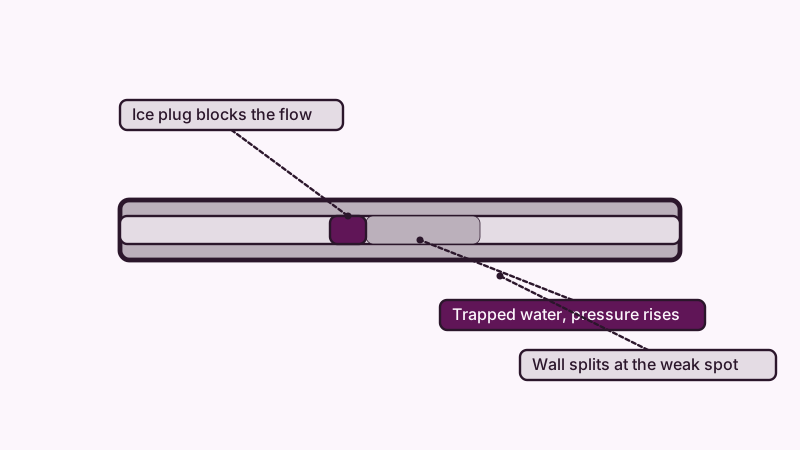
A pipe bursts when internal pressure beats what the pipe wall can hold, or when the wall has been worn thin enough to give way. Around Torrance and the South Bay, the common culprits are household pressure set too high, metal that has corroded with age, and surges from a faulty regulator or water heater. If one has just let go, begin with our overview of leaks and burst pipes, then return here for the reasons.
What actually makes a pipe split open?
Five causes cover most bursts: pressure beyond the pipe's rating, corrosion working from either face of the wall, heated water expanding with no outlet, damage from roots, digging or settling soil, and ice. Aged pipe worsens each of them, since a thinner wall gives first.
Pressure is the stealthy one. Building rules in California expect a regulator whenever resting pressure rises beyond 80 psi, and an expansion tank is often needed in a closed system so warmed water cannot push pressure past that mark. Rheem suggests holding household pressure between 40 and 60 psi to spare tanks and connections. Corrosion is the slow one; per Wikipedia, galvanized steel rusts inward and lasts roughly four to five decades. Combined, they explain why one failure in an old house so often precedes the next.
Does cold weather burst pipes in Torrance?
Seldom. Ice swelling inside a pipe is the classic cold-climate failure, yet hard freezes rarely visit the coastal South Bay. Only exposed lines in an unheated garage or along an outside wall face real risk, and wrapping them takes minutes ahead of a cold forecast.
If you ever do get a cold snap, pipes on exterior walls, in unheated garages and outdoors are the first to suffer. Insulate exposed runs, open the cabinet under a sink on an outside wall, and let a faucet drip. Many people searching for why pipes burst in winter live inland or in the mountains, and the answer there is freezing. Here, a burst in a cool week is more likely a pressure or corrosion failure that happened to surface then.
Do pipes burst in summer too, and why?
Often, and pressure is to blame rather than heat: high street pressure overnight when demand falls, a failing regulator, heated water expanding in a sealed loop, the shock from a valve that slams shut, or a sun-weakened plastic line outdoors. Sprinkler and irrigation runs suffer most.
Warm weather also stresses the water heater, because heated water expands. If a one-way valve on the supply blocks the return path and there is no expansion tank, pressure has no escape and rises. Sun makes exposed plastic brittle across the years. Hammer announces itself with a thump as a tap snaps shut; that banging noise is a shock wave worth curing. An outdoor burst tends to appear as a sudden wet patch plus a faster meter.
How do old and corroded pipes fail?
Metal pipe thins from the inside, develops pinholes, then splits at a joint or weak spot. Galvanized steel narrows as rust builds. Copper can pit where water chemistry is aggressive. Polybutylene, installed in many houses from about 1978 into the 1990s, tends to give up at fittings and bends.
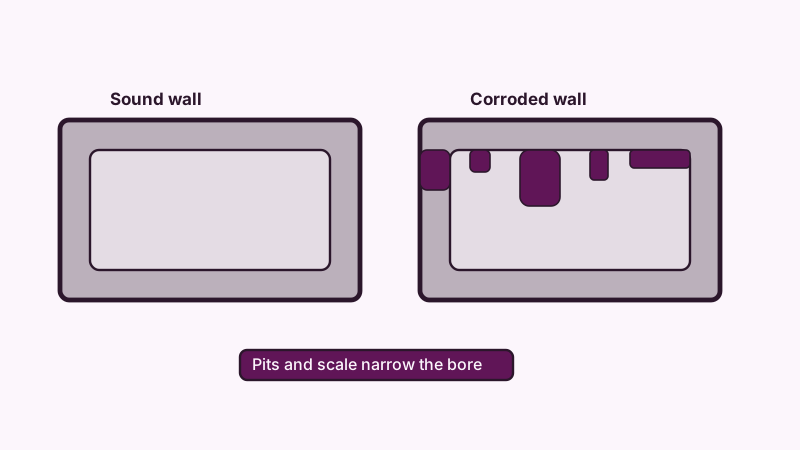
Hard water adds scale, which chokes flow, raises stress and collects in water heaters. Cal Water's 2025 report for Hermosa-Redondo lists average groundwater hardness near 502 ppm. In a postwar tract home with original supply lines, a plumber can often identify the material by eye and use a pressure test to find weak points. When pipe is spent, galvanized pipe replacement explains the repipe route.
How can I recognize a burst or a pipe close to bursting?
Watch for marks spreading across plaster, a musty odor, blistering paint, warped flooring, pressure that suddenly falls, trickling sounds in a silent house, and a meter dial that refuses to sit still. A major burst adds flooding, hissing and a cold patch along the pipe's path.
Ceiling symptoms have their own write-up: signs of a water leak in a ceiling explains stains, sagging and dripping. To check for a concealed leak, close each tap, then keep an eye on the meter. EPA's household leakage figure tops 9,300 gallons yearly, which shows how a small hidden one accumulates. A longer symptom list lives on our page about telling whether a pipe has burst.
Can I tell whether my water pressure is too high?
Yes, with a hose-bib gauge, an inexpensive tool that screws onto an outdoor tap. Read it when no water is running. Static pressure above 80 psi is the point where California's plumbing code calls for a regulator, and the 40 to 60 psi range is easier on the system. High readings mean a regulator needs adjusting or replacing.
Many houses carry a pressure-reducing valve beside the main shut-off. A failing one can let pressure creep up unnoticed, particularly overnight. Where the regulator sits and how swapping it works each have a page, including pressure regulator replacement. Fit an expansion tank near the water heater if the system is closed off by a one-way valve, and have the relief valve tested.
Which steps cannot wait when a pipe splits?
Shut the main water valve and turn the water heater off. If water has reached sockets or appliances, isolate the power at the panel, but only when the floor before it is dry. Open the lowest taps to empty the line, lift belongings clear, take photographs and phone a plumber.
Water meeting electricity is lethal, so a wet floor around the panel means keeping away and calling for help instead. Should gas ever smell, go out first and SoCalGas takes the call at 1-800-427-2200 once you are outdoors; 911 covers real danger. More help: emergency burst pipe plumbers describes a visit, and burst water pipe repair the fix. Photos help a claim; insurance and burst pipes explains typical coverage.
What keeps the next burst from happening?
Measure the pressure, replace a failing regulator, fit an expansion tank wherever the system calls for one, retire pipe that has outlived its years, trim roots near buried lines, and learn your main valve's location. Flushing scale from the water heater yearly helps too, and a pipe inspection after any burst is worth the time.
A plumber will test pressure and look over exposed pipe, valves and fittings during any visit. The quote form starts one, and the home page shows everything else we line up.
Common questions
Why do pipes burst?
Pressure beyond the pipe's rating, a wall thinned by corrosion, heated water expanding in a sealed loop, damage from roots or digging, and frost. In older homes corrosion and high pressure team up, so pipe that held for decades can split without warning.
Can a pipe burst without freezing?
Yes, and in Torrance it usually does. High water pressure, a failed regulator, water hammer, corroded pipe and damaged fittings all cause bursts in mild weather. Freezing needs a hard overnight frost, which is unusual on the coast. Pressure and age are the better suspects here.
Which warning signs show up before a pipe bursts?
A damp mark spreading on plaster, a musty odor, sagging pressure, trickling noises when nothing is running, and a meter turning with every tap closed. A concealed leak can run for weeks, which makes any of these a cue to investigate, never a reason to wait.
How much pressure is too much for household plumbing?
Under the state code a regulator is needed once resting pressure goes over 80 psi, and Rheem suggests 40 to 60 psi. An outdoor-tap gauge reads it in a minute. Above 80, a plumber can adjust the regulator or replace it.
Should I replace old pipes before they burst?
With galvanized or polybutylene pipe, or any run that has leaked repeatedly, a repipe quote is sensible. Galvanized steel lasts about four to five decades and polybutylene fails at fittings. After inspecting, a plumber can price the work on paper so you plan the job instead of reacting to a flood.
Sources used
- California Plumbing Code 2025, section 608.2 Excessive Water Pressure (summary)
- Rheem, water heater maintenance and pressure range
- Wikipedia, Galvanization (inside-out corrosion, 40 to 50 year life)
- Wikipedia, Polybutylene (use from about 1978 to 1997, failure at fittings)
- U.S. EPA WaterSense, Fix a Leak Week
- Cal Water, 2025 water quality report for Hermosa-Redondo
Last updated