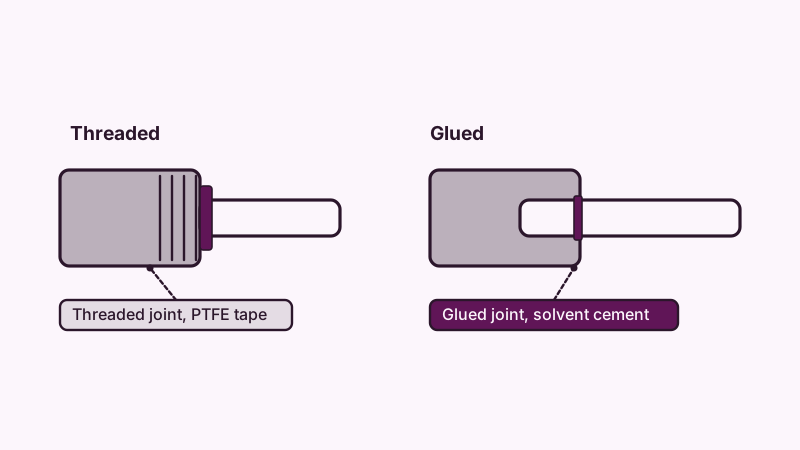
Avoiding the saw hinges on how the joint was made. A threaded joint or union can be unscrewed, cleaned, wrapped with thread tape and tightened again, no cutting needed. A glued (solvent-welded) joint is chemically fused, so once it weeps, the lasting remedy is nearly always to cut the fitting out. Both cases are covered here, as a narrow branch of our wider leak help.
Is the leaking PVC joint threaded or glued?
A threaded joint has visible screw threads at the fitting, a union nut, or an adapter into a valve or tank. A glued joint is a smooth socket where one pipe slides inside another, with a hard bead of cement showing at the edge. The type decides the fix.
Look at the joint closely after drying it. Smooth sockets, often with a purple or clear primer stain, are solvent welded, meaning cement has fused the two surfaces. Threaded joints show raised ridges, often at transitions to metal valves, pump fittings or irrigation heads. Rubber-gasket couplings are a third type, found on some drains. Knowing which you have saves a trip to the store for the wrong product.
How do I stop a threaded PVC joint from leaking?
Close the water, unscrew the fitting, scrub the threads, then wrap PTFE thread tape on them in the direction the fitting turns, and screw it home finger-tight with a slight extra nudge. Overtightened PVC threads crack, so move slowly and stop when it feels snug.
Use three to four wraps of tape, covering the male threads evenly, and avoid pipe dope with petroleum solvents on PVC, since some compounds attack plastic; use one labeled safe for PVC. A leaking union usually needs a new O-ring inside the nut, not more force. Replace any cracked collar, because a hairline crack will not hold. After reassembly, restore pressure slowly and watch for several minutes. If a threaded fitting leaks again, the female thread may be damaged and the part needs replacing.
Can I fix a leaking glued PVC joint without cutting it?
Only as a stopgap. Epoxy putty, a fiberglass resin wrap or a rubber clamp can slow or stop a weep for a while on a clean, dry joint with the water off. Since the glued bond itself has failed, the dependable repair is to remove the joint and fit a new coupling.
Treat these as bridges, not fixes. Dry the fitting, scuff the surface lightly, press two-part epoxy putty into the gap and follow the label's cure time, often an hour or more before pressure returns. A padded clamp can hold a pinhole, and a resin-soaked fiberglass wrap hardens around the fitting. None suits a permanent job on a pipe under constant pressure; a waste joint that carries no pressure is easier to hold than a supply line. Smearing more cement over a wet leak does not work.
Why do PVC joints leak in the first place?
Common causes are an incomplete bond from the original install, a pipe not pushed fully into its socket, shifting ground or settling that strains the joint, water hammer, sun-damaged pipe outdoors, and threads overtightened until they crack. Pressure over the system's limit makes every one of these worse.
Look for a pattern. A joint that has dripped since installation probably had a poor bond. One that failed years later often reflects movement, such as an unsupported pipe, or stress from hammer when a valve slams shut. Hammer noise is a pressure shock worth curing. Sunlight turns exposed PVC chalky and brittle. Building code in California expects a regulator when resting pressure passes 80 psi, so repeated joint failures alongside high pressure justify a gauge test. Related reading: why pipes burst.
What is the lasting repair if I do have to cut?
Remove the damaged joint and fit a new coupling, either solvent-welded using primer and cement, or a slip coupling that slides over the gap. A slip coupling lets you repair without shifting the pipe ends, handy when the pipe is anchored.
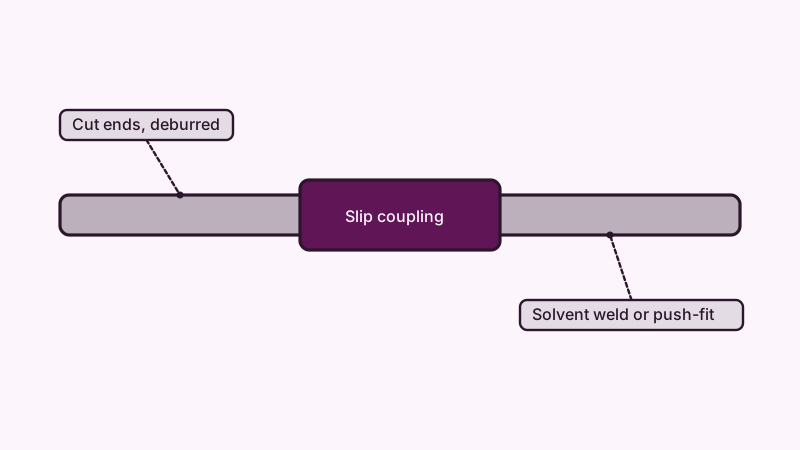
Order of work: water off, line drained, cut marks made and squared off either side of the fitting, burrs removed, dry fit, primer, cement, a quarter-turn push together and a hold for the period the can specifies. Full cure comes before pressure returns, and cure times shift with pipe size, temperature and product, so the label rules. Push-fit couplings rated for PVC work where space is tight. Whole runs of old, brittle pipe are better replaced; see leaking water pipe repair.
Which PVC leaks are not a home repair?
Pass it to a plumber if the water comes from behind a wall, ceiling or slab, the pipe is large or part of the main, the joint carries sewage, it leaks again after a repair, or the supply cannot be closed. Gas, electrical and structural risks are never DIY.
The plumber, who needs a California contractor license, can cut out and rejoin the pipe, pressure-test the repair and look for the cause. License checks are at cslb.ca.gov. Work on main lines or big repipes goes through the city's permit counter at Building and Safety. If water is spreading fast, see urgent burst pipe help. A visit starts at our quote form, and you can read about our other services on the home page.
Is a small weep really worth worrying about?
More than the small drip suggests. EPA says household leaks can waste more than 9,300 gallons a year, and a faucet dripping once a second can waste over 3,000 gallons a year. A weeping joint on a pressurized line could account for losses like that.
Moisture does slower damage too: rotted cabinet floors, mold, stained ceilings and soft drywall. Outdoors, a weeping joint can undermine soil and slowly flood a planter bed. To hunt a hidden joint, try EPA's meter test: write down the meter reading, leave all taps off for two hours, then compare. A changed number points to a leak somewhere in the system.
Common questions
Can you fix a leaking PVC joint without cutting it?
Sometimes. Threaded joints can come apart, get tape and be retightened. Glued joints can be slowed with epoxy putty, a clamp or a resin wrap, but those are temporary, and cutting out the fitting is the lasting answer. Whether you can skip the saw depends on joint type and location.
Will PVC cement fix a leaking joint?
Not on a wet joint, and not as a patch over a failed bond. Cement works by softening both surfaces so they fuse, which needs clean, dry, fitted pipe. Smearing it over a leaking joint rarely seals it. The reliable fix is to cut the joint out and rejoin with primer and fresh cement.
What tape works on PVC?
PTFE thread tape suits threaded PVC joints, wrapped in the direction of tightening. Self-fusing silicone tape can wrap a small leak temporarily on a dry pipe. Duct tape and electrical tape do not hold against pressure. Neither tape repairs a glued socket joint for good.
How long does epoxy putty last on a PVC leak?
No fixed figure applies, because pressure, pipe condition and preparation all matter. On a low-pressure drain it may last a long time, while on a pressurized supply line it can fail without warning. Treat it as a bridge and book a proper repair.
Does a leaking PVC joint need urgent attention?
A spray or steady flow is urgent: shut the water and ring a plumber. A slow weep can wait for an appointment, though it wastes water and harms its surroundings. Near outlets, keep away; cut power only if getting to the panel does not mean wading through water.
Sources used
Last updated