Mop the floor dry, then sit a sheet of cardboard under the heater and come back in twenty minutes. The wet patch on the cardboard and the damp spot on the tank usually give the answer. Beads of water on a pipe fitting can be dealt with, and so can a weeping relief valve. Water oozing out of the steel body, low down, means the tank has given up. Think of this as the how-to companion to water heater repair in Torrance; the checks run in the order a tradesperson would take them.
Where on the heater is the water escaping?
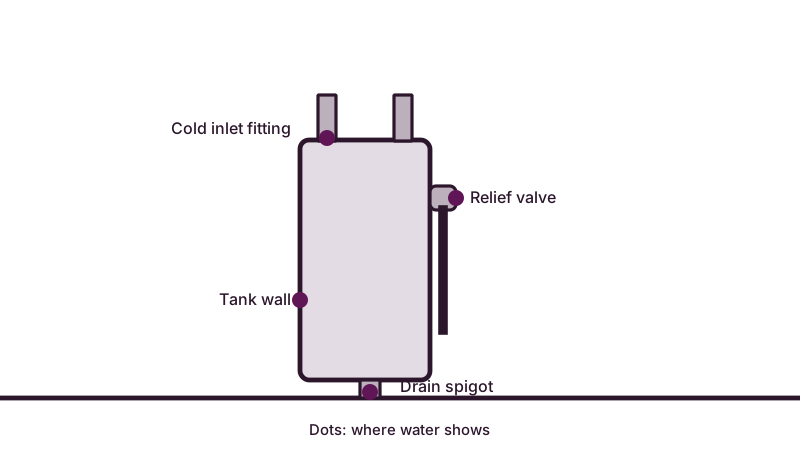
Dry everything, wait, and trace the drops upward. A leak at the top is a supply connector or a union. A trickle halfway down the side usually belongs to the relief valve or whatever pipe is attached to it. Water pooling at the base is the drain spigot, a burner-compartment seep, or the tank wall. Wet insulation under the jacket points at the tank.
Rule out harmless moisture before you worry. Condensation can bead on a chilly tank in a damp garage, and it vanishes by morning without growing. Real leaks come back and grow.
What each location usually means:
- Cold inlet or hot outlet fittings. Threads that have crept loose, or a corroded dielectric nipple. Often a small job.
- Relief valve. Either the valve itself has worn or the tank is running too hot or too high in pressure. Its job is protection, which is why nobody should cap or plug its outlet.
- Drain spigot. Many are plastic and weep after years of heat.
- Bottom of the tank, or from under the jacket. Corrosion has gone through the steel. This is the case with no repair.
- Burner area on a gas model. Condensation, or a leak from the tank above. Add a gas smell and the problem is a different one, covered below.
What can I safely do to stop a leaking water heater?
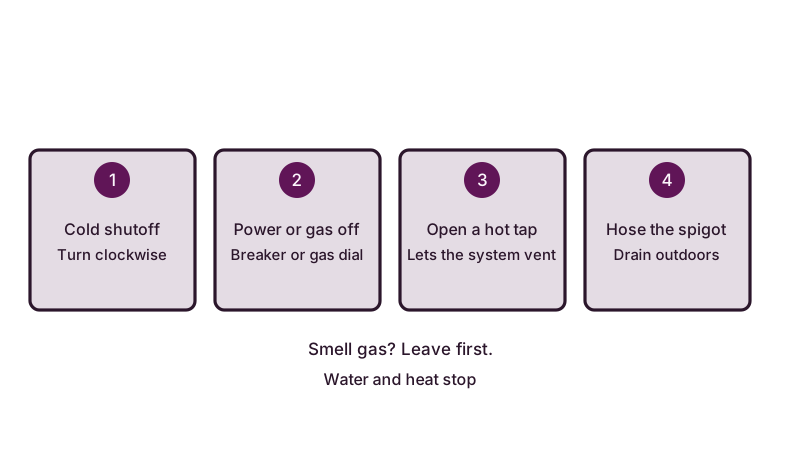
First locate the shutoff on the cold line that enters the top of the tank. Then remove the energy source: breaker off, or gas dial to its off setting. Finally open one hot faucet elsewhere so the system can vent. Water and heat both stop. Swapping a weeping drain spigot is a reasonable home repair. Gas piping, the relief line and the tank wall are not for amateurs.
The sequence, once you are standing in front of it:
- Find the cold water shutoff on the pipe going into the top of the unit and turn the handle clockwise.
- On an electric heater, switch the dedicated breaker off. On gas, turn the knob to its lowest setting or off. If you smell gas, leave instead.
- Open any hot tap in the house, which keeps the system from pushing water through the leak.
- If water is still escaping from low on the tank, hose the drain spigot to the outdoors.
The discharge from a relief valve is hot enough to scald, and the whole assembly is under pressure, so replacing one is a job where a plumber's hands are cheaper than a burn. If you would rather have help, our water heater leak page shows what a visit involves.
How can I tell the tank is beyond repair?
Seepage through the shell, rust trails on the jacket, saturated insulation, or a puddle that returns even after every fitting is snug: any of those condemns the tank. Nothing seals it for long. The glass lining inside has cracked or the sacrificial anode rod has been used up, and the steel is rusting through from the inside.
Local water works against tanks. Cal Water's 2025 report for the Hermosa-Redondo system lists groundwater averaging about 502 ppm total hardness, well inside the report's "very hard" band of 300 ppm and above, while its imported supplies run softer (roughly 88 to 236 ppm on average). The report notes that mineral buildup can form in pipes and water heaters, and what reaches your tap depends on the blend serving your street. Sediment baked onto the tank floor attacks the glass lining. Replacing the rod early can buy extra years, and anode rod replacement walks through it.
Treat a failing tank as a countdown. A split tank can release its entire 40 to 50 gallons within minutes, which matters if the heater stands in a hall closet over wood flooring or inside a unit above a neighbor. Shut it down and arrange a replacement soon.
Does a gas odor change the plan?
Go outside first. Skip the light switches, the lighter and the indoor phone. Walk out, then ring SoCalGas on its leak number, 1-800-427-2200. Keep 911 for any situation with a risk of injury. A plain water leak is not a gas leak, but gas odor at a water heater goes to the gas company ahead of any plumber.
SoCalGas tells customers not to repair a gas pipe or meter themselves, and not to reopen a meter they have closed. The company relights it. The flexible connector and shutoff valve at the heater count as gas piping, so a California plumbing contractor should handle them. Torrance treats water heater work as permit work, run through the Building and Safety office. Renters should tell their landlord the same day. For the wider rules, see gas line work in Torrance.
Is a repair worth it, or is it time for a new heater?
A new valve, element or fitting costs a fraction of a heater, but a failed tank always means replacement. National published guides put a replaced water heater at about $748 to $2,138 installed, a gas tank near $1,239 to $1,353 and an electric tank near $1,080, with a permit often $50 to $200 and about $100 for hauling the old unit away.
Remember these are national guide numbers, with no Torrance quote behind them. A plumber prices your unit after seeing the venting, the access and any code updates the new heater needs. Age tips the balance. An old heater with a weeping tank or corroded fitting seldom merits another repair. For new-unit pricing see what a replacement heater costs, and for lifespan see when a heater should be retired.
Is the fix different for Rheem, Whirlpool or Bosch units?
Hardly. All three leak for the same reasons, and the checks run in the same order. What changes is parts. Elements, thermostats, rods and valves are not interchangeable between models. The label on the tank gives the model and serial number a parts order requires.
Take a photo of that plate when you call. That label shows capacity and build date, which tells the plumber whether parts still exist. Tankless water heaters are different again. A tankless unit stores almost nothing, so its leaks tend to be a fitting, a condensate line or a scaled heat exchanger; on hard water, descaling is routine. For hot water repair on a specific brand, a plumber who has worked on that model matters more than the logo.
What routine care keeps a heater from leaking again?
Each spring and fall, let a few gallons run from the drain spigot into a bucket. Lift the test lever on the relief valve for a second with a bucket beneath its pipe. Every few years, pull the anode rod and look at it. Keep boxes away from the unit, and fit a drain pan piped to a safe discharge where a spill would ruin a floor.
Maintenance costs a little time. A flooded garage costs far more. If your water is hard, ask about a softener or scheduled descaling, and see hard water scale prevention. A heater that is dry but delivers a weak trickle has another problem; see low hot water pressure.
Common questions
The tank is dry yet the water runs cold. Where do I look?
For electric heaters, find the breaker, then the red reset button hidden behind the upper thermostat cover. For gas, make sure the pilot flame exists and the control dial is set to on. Failed elements, thermostats and thermocouples cause most cold-water complaints. A pilot that goes out repeatedly, or any gas smell, means stopping and calling for help. More is on losing hot water in the shower.
Does a leaking water heater need same-day attention?
A drip from a fitting can wait a day once you close the supply and catch the water. A tank pouring water, or a leak near wiring, is an emergency. Close the cold valve, cut power or gas, and drain the tank where you are able to. A hiss or gas smell means leave and phone SoCalGas.
Will sealant fix a hole in the tank?
No. Epoxy and tank sealants do not last on a pressurized steel tank rusting from inside, and the leak returns, often worse. A hole in the tank wall means the lining and steel have failed. The lasting answer is a new heater fitted under a plumbing permit.
Does Torrance require a permit to swap a leaking water heater?
Yes. The City of Torrance lists water heaters under its plumbing permit, along with pipes, fixtures and sewer work, and applications go through Building and Safety online; the office number is (310) 618-5910. Normally the plumber files it. Ask for the permit number, because it helps when you sell and when you claim.
What will a repair visit cost?
We have no checked price for repairs, since the part, the access and the make all change it. A plumber quotes once the leak is diagnosed. For comparison, national guides put full replacement in the hundreds to low thousands of dollars. Request a written quote and have repair and replacement priced side by side.
The rest of our guides start from plumber torrance.
Sources used
- SoCalGas, shutting off natural gas
- SoCalGas, natural gas leaks
- City of Torrance, Building and Safety FAQ
- Cal Water, 2025 water quality report for Hermosa-Redondo
- Water heating, Wikipedia
- National published water heater price guides, checked November 2026
Last updated