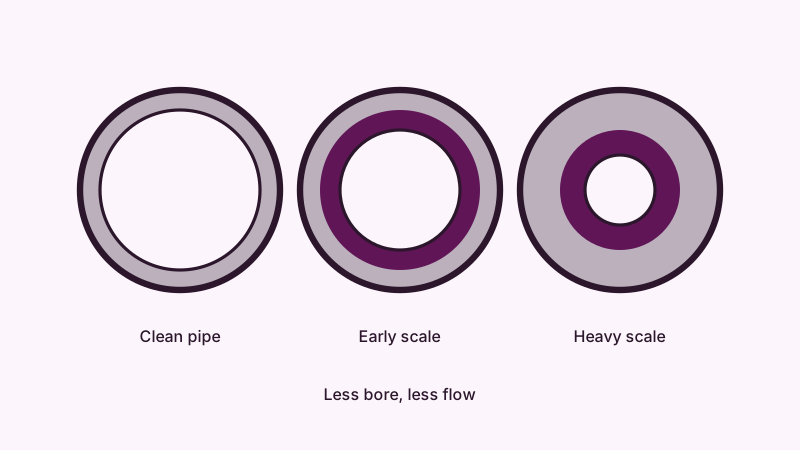
Scale comes from dissolved calcium and magnesium that drop out of water as it heats or dries. You can slow it with a lower water heater setting, a yearly tank flush and quick wiping of fixtures, and you can stop most of it with a softener. Which of those fits depends on your hardness reading, and our water softener plumber page picks up.
Where does scale come from?
Dissolved calcium and magnesium ride along in hard water. Warm it, or let a droplet dry on a faucet or shower door, and those minerals separate into a hard white or tan crust. Heat speeds it up, so the water heater, kettle and dishwasher show scale first. That crust insulates, clogs and wears moving parts.
By the USGS definition, hardness is simply the calcium and magnesium content, and very hard water leaves scaly deposits inside pipes, boilers and tanks. There is no federal limit on hardness, because the minerals are not toxic. Scale is a cost and comfort problem, not a health standard.
The signs are easy to spot: white rings at a faucet base, a showerhead that spits in odd directions, cloudy glasses from the dishwasher, and a tank that grumbles and crackles during heating, because steam gets trapped beneath the sediment. Our page on whole house softener costs covers the price of fixing the cause rather than the symptoms.
How do I read a hardness number: ppm, mg/L or grains?
Ppm and mg/L are the same thing here. Counting down from the top of the USGS scale: above 180 mg/L (as calcium carbonate) is very hard, 121 to 180 is hard, 61 to 120 is moderately hard, and 60 or under is soft. Softener sellers prefer grains per gallon, where one grain equals roughly 17 mg/L, so dividing a ppm reading by about 17 converts it.
That makes a reading of 171 ppm roughly 10 grains per gallon. Hardness is a different measure from pH. A pH reading tells you how acidic or basic the water is, not how many minerals it carries, so a pH test strip will not tell you about scale. Use a hardness test strip, a drop-count test kit, or your water supplier's report.
For a Torrance address, the answer is not one number. The city operates its own municipal water system and draws on a mix of local wells and imported supply, so hardness can shift between neighborhoods and seasons. Published estimates I found range from the moderately hard band into the very hard band, so I am not quoting a single figure. Check the current Torrance water quality report for your supply, or test at your tap.
How can I slow scale without buying anything big?
Three habits help immediately: keep the water heater at about 120 degrees Fahrenheit, which the Department of Energy recommends, wipe fixtures dry, and flush the water heater tank once a year to remove sediment. Lower temperatures slow mineral deposits and cut scalding risk. Descale showerheads and aerators with white vinegar when they begin to spray unevenly.
For a tank heater, the yearly flush is a garden hose on the drain spigot low on the tank, with water released until it looks clean. Only do this if the valve opens and closes cleanly. An old valve that sticks open can turn a chore into a leak. If nobody has opened yours for ten years, let a plumber do it.
To descale a showerhead, unscrew it, leave it in a vinegar bath for an hour, scrub the nozzles lightly, rinse, then refit it. Some finishes and natural stone dislike acid, so test a hidden spot. Kettles and coffee makers respond to the same treatment.
Do softeners, conditioners or filters stop scale?
A salt-based softener swaps hardness minerals for sodium, and it is the proven way to stop scale across a whole house. Template-assisted conditioners and electronic descalers claim to change how minerals crystallize rather than remove them, and the evidence for them is mixed. A plain carbon filter removes chlorine and taste but not hardness.
A softener has trade-offs worth knowing. It needs salt, it uses some water to regenerate, and it adds a small amount of sodium. In parts of California the salt in regeneration wastewater has led to local limits on those units, so ask the City of Torrance before buying. Our water softener installation page lays out what installation involves and how it is priced.
A house with just one or two complaints might manage with a small local fix, like a cartridge on the kettle. If the heater, dishwasher and every faucet are scaling, whole-house treatment makes more sense. Do not size one by guesswork: get a hardness reading first.
Will scale shorten the life of my water heater?
It can. Scale and sediment settle on the tank floor and shield the water from the flame or lower element, so the heater struggles, rumbles, and may fail early. A storage tank is expected to last 10 to 15 years, per federal guidance, and heavy mineral loads can eat into that.
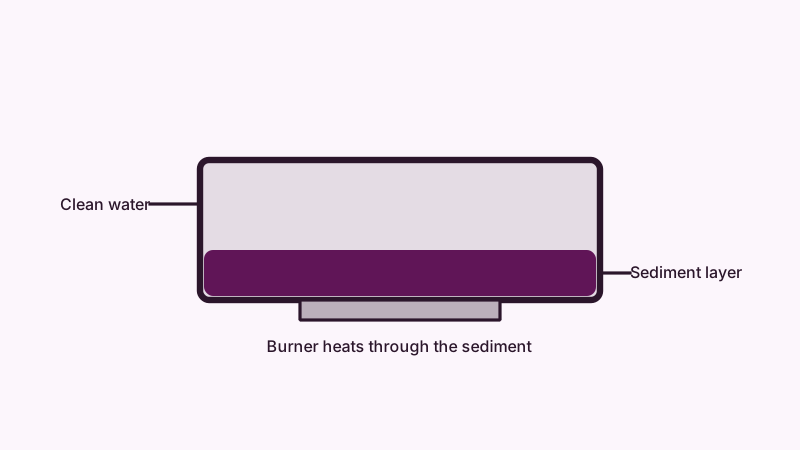
In a gas tank, a layer of sediment can overheat the steel at the base. In an electric tank, scale on an element makes it burn out. A water heater anode rod also wears faster in hard water, so asking for an anode check at a service visit is sensible. If your tank is already old, read water heater replacement costs before spending on repairs.
Scale can also narrow pipes over time, especially old galvanized lines in postwar Torrance houses. If water pressure drops through a whole house, scale may be one reason. We cover that in the pressure pages. To discuss treatment or an inspection, request a quote. Requests are read on weekdays, nine to five.
Common questions
Why does scale form on fixtures and heaters?
Mostly dissolved calcium and magnesium. Heat or evaporation drives them out of solution as a crust, and more heat means faster crust, so heaters, kettles, shower doors and faucet tips go first. That is why a tank heater may rumble long before any pipe shows trouble, and why a dishwasher leaves a film on glassware.
Can existing crust be removed?
On parts you can unscrew, such as showerheads and aerators, a vinegar soak followed by a brush works well. Crust inside a tank or pipe will not respond to that. A plumber can flush a tank, or say whether replacing the part makes more sense.
What hardness level needs a softener?
There is no legal line, because hardness is no health hazard. Many owners start considering treatment once readings pass 120 mg/L, the hard band of the USGS scale, and scale starts showing. It is a choice about appliance life and comfort.
Is hard water unhealthy?
Calcium and magnesium are not toxic, the USGS notes, and the EPA has set no limit for hardness. Hard water can dry skin and leave soap residue for some people, but it is mainly an appliance and plumbing nuisance. Talk to a doctor about any skin concern.
For the wider picture, start with Del Amo Plumbing plumber.
Sources used
- U.S. Geological Survey, hardness of water (classification in mg/L as calcium carbonate)
- U.S. Department of Energy, Energy Saver guide (water heater temperature and life)
- City of Torrance, Torrance Municipal Water annual water quality report (read the current edition for your supply)
Last updated