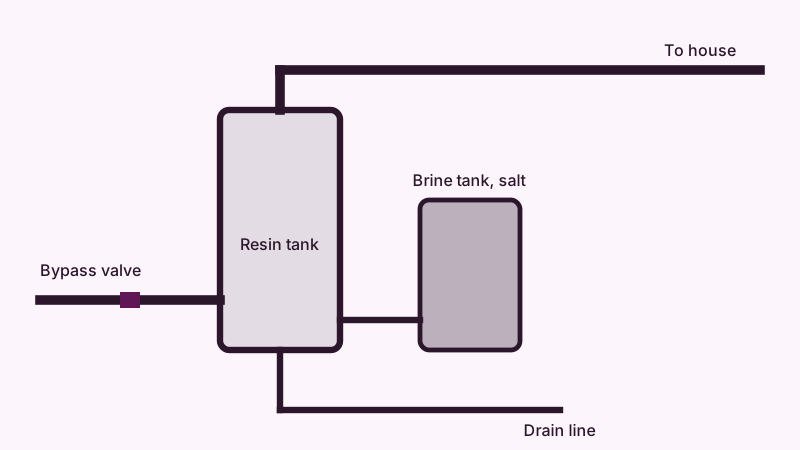
A salt-based softener is plumbed into the house's main line and strips out calcium and magnesium, the hardness minerals, as the water passes through a bed of resin beads. The beads are recharged from time to time with a salt brine, which flushes the minerals down a drain. A plumber installs the unit on the main line, adds a drain and a bypass, and tests it. See our water softener plumber guide for the full service in Torrance and the South Bay.
What happens inside a salt-based softener?
Hard water flows through a tank of resin beads that hold sodium. Calcium and magnesium cling to the beads and sodium goes into the water, a process called ion exchange. When the beads fill with minerals, the control head runs a regeneration: brine from the salt tank washes the minerals out of the resin and down the drain.
That is why the unit needs salt, an electrical outlet and a drain. A salt-free conditioner works differently and does not remove hardness, so only a salt-based system gives truly softened water. Water from a softener feels slick, lathers more easily and leaves fewer spots and less scale on fixtures and in a water heater.
The tradeoff is sodium. Softened water carries more of it; anyone on a sodium-restricted diet should consult a doctor, and the system can be arranged to leave one cold tap untreated.
Is my water hard enough to need one?
Torrance's water is a mix of imported and groundwater, and it is mineral-rich. Torrance Municipal Water's 2025 report shows total dissolved solids around 696 ppm in its groundwater and about 541 ppm in imported supply. The report does not list hardness as a number, so test your own tap.
Neighboring Cal Water's 2025 report for the Hermosa-Redondo system, which serves part of the South Bay, shows groundwater hardness around 502 ppm and classes it as very hard. Hardness differs by city and by supplier, so check the report for the utility that serves you.
Telltale signs: chalky crust around faucets, cloudy glasses, a scaly kettle and a rumbling water heater. Symptoms and cheaper remedies appear in stopping hard water scale and removing it.
What steps make up the installation itself?
The plumber picks a spot near the water main, ideally with a power outlet and a floor drain or standpipe nearby. Garages are common in the South Bay. The water is shut off, the main is cut, and the softener goes in with a bypass valve so you can isolate it. A drain line leaves the control head for a floor drain or standpipe, with an air gap preventing backflow.
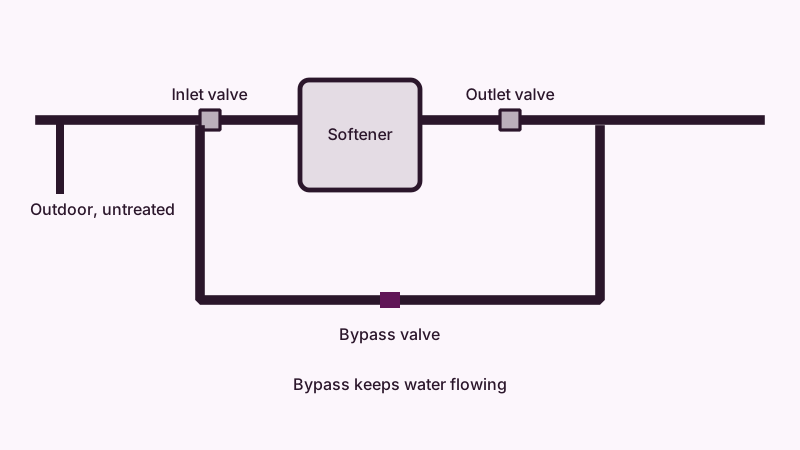
Pipes that feed the outdoor hose bibs are teed off before the softener so the garden gets untreated water. California's Health and Safety Code section 116785 requires that for residential installations that discharge to the sewer. The plumber fills the salt tank, sets the hardness and the regeneration, runs a manual regeneration and checks every joint.
The job commonly takes half a day, a little more if new pipe is needed. The water stays off for a few hours. See that the quote names the bypass, drain, fittings and a first bag of salt.
What does California require of a water softener?
California's Health and Safety Code, section 116785, sets conditions for home softeners that discharge to a community sewer. Regeneration must be triggered by demand control, not a fixed timer. Units installed on or after January 1, 2002 must meet a salt efficiency rating of at least 4,000 grains of hardness removed per pound of salt.
The same section requires water-saving devices on softened-water fixtures, such as faucet flow restrictors, shower head restrictors and toilet reservoir dams, with exceptions where they are already present or prohibited. It also requires the outdoor supply to carry untreated water, with limited exceptions.
Separately, section 116786 lets a local agency limit or ban new residential softeners by ordinance if it makes specific findings tied to salt discharge. It cannot make you remove one already installed. Ask the city or the sanitation agency whether a local rule applies before you buy.
From $1,000 a contractor's license is mandatory in California, and permitted work sits beyond the handyperson exemption. Ask Torrance Building and Safety at 310-618-5910 whether a plumbing permit applies to the connection.
What does a salt-based softener installation cost?
Cost guides show salt-based softeners installed between roughly $1,200 and $3,800, averaging $2,500 nationally. The unit itself is typically $400 to $1,200 for a standard single-tank system, and plumber labor commonly falls between $500 and $700, though guides range from $150 to $1,000. California labor tends to be higher.
| Piece | Guide figure |
|---|---|
| Single-tank unit | $400 to $1,200 |
| Plumber labor | $500 to $700 typical, $150 to $1,000 range |
| Installed total | $1,200 to $3,800, average $2,500 |
| Salt, per year | About $50 to $150 |
| Dual-tank unit, installed | $1,700 to $5,000 |
Labor climbs if the plumber has to run fresh supply lines, add a brine drain or squeeze into a crawl space. Guides vary, and a local written quote settles the real figure. See water softener installation cost and whole-house softener cost for more on how the numbers break down.
How much upkeep does a softener demand?
Check the brine tank regularly and keep salt in it, usually checking monthly and topping off when it drops under a third. Break up any salt bridge, a crust that stops the salt from dissolving. Clean the tank occasionally. Check the hardness setting if the water starts to feel hard again.
Water bills can shift with a softener; softener effects on the water bill explains how. Regeneration uses water, and a demand-initiated unit uses less than a timed one. Follow the manufacturer's instructions for resin cleaning and service, since the maker's guidance beats any general rule.
A price begins on the quote form, and someone local follows up. Browse everything else on the Del Amo Plumbing home page.
Common questions
Will installing it take most of a day?
Most installs take about half a day for a single-tank unit when the layout is simple. A long run of new pipe, a drain that must be added or a tight crawl space can stretch it. You will be without water for a few hours while the main is cut and the unit is connected.
Which points go on my installer checklist?
Request the contractor license number, brand and capacity, whether regeneration is demand-initiated, who files any permit, and what the quote covers: bypass, drain, fittings, salt and the hardness setting. Ask how the outdoor hose bibs will stay on untreated water.
Do I have to be on site while it is fitted?
Show up at the start to indicate the water main and the chosen spot, and at the end to learn the settings and approve the work. Water goes off for a few hours, so do the laundry and dishes first.
Can I drink softened water?
Softened water holds more sodium than what entered the system, so a doctor should weigh in first for anyone on a sodium-restricted diet. Many installs leave the kitchen cold tap or a separate line unsoftened for drinking and cooking. The plumber can set that up if you ask before the work.
Sources used
- California Health and Safety Code section 116785, residential water softeners
- California Health and Safety Code section 116786, local limits on softeners
- Cal Water, 2025 water quality report for Hermosa-Redondo
- City of Torrance, 2025 annual water quality report
- Published 2026 water softener cost guides (HomeGuide and plumbing trade guides), checked November 2026
Last updated