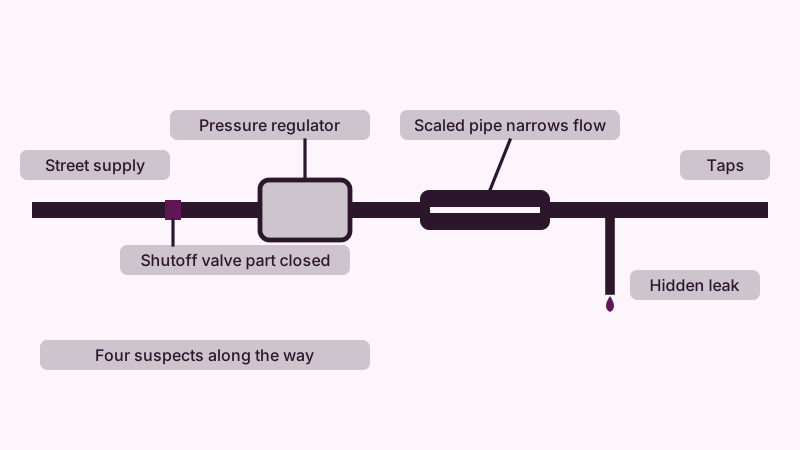
Four suspects cover nearly every weak-pressure complaint in a house: a valve turned less than fully, a worn regulator, pipe that has silted up inside, and water escaping before it reaches you. One lazy tap is a different story, local to that fixture. Fixing it is covered on the plumber page for low water pressure; here the aim is to identify the guilty one.
Does every tap run weak, or only one?
Walk the house and open a tap in each bathroom and the kitchen. One weak tap among strong ones means the trouble is at that spout, usually a crusted aerator, a showerhead full of scale or a half-turned stop valve. If all are weak, the main, the regulator, the piping or the street comes under suspicion.
That split spares you a lot of guessing. An aerator unscrews by hand and soaks clean in white vinegar. Weak on the hot side only? Then the heater and its piping take the blame, the subject of hot-side pressure trouble. A lone kitchen faucet is handled in a weak kitchen tap. From here on, assume the whole house is affected.
Is a shutoff valve sitting partly closed?
Check this first, since it costs nothing. One main valve sits where the supply comes in, and a second often sits out at the meter. Either can sit a quarter turn shut after a repair or a meter read, and a stiff old gate valve may never have been reopened fully.
Look for the main by the front hose faucet or on the garage wall. Wheel handle: turn it counterclockwise until it stops. Lever handle: the lever lies along the pipe when open. A bell-shaped brass body downstream of the main may be a regulator. Resist the urge to turn its screw to see what happens; finding the regulator explains what you are looking at.
What is my actual pressure, in numbers?
Pick up a ten-dollar gauge that screws onto a garden-hose thread, put it on an outdoor spigot with all indoor water off. Open the bib and read the needle. Roughly 40 to 60 psi is the comfortable band; under 40 is weak, and over 80 is a code issue because a regulator is then required.
Take a reading at breakfast and again in the evening. Street pressure moves with demand, and a regulator that misbehaves often shows itself by swinging. Strong at the bib but feeble upstairs hints at narrowed pipe, while a feeble bib reading blames the valve, regulator or supply. Torrance Municipal Water can tell you if crews are working near your address. Scribble the numbers down; any plumber you call will want them.
How does a bad pressure regulator behave?
It can fail in either direction. The diaphragm inside tires or the seat gets gritty, and the valve either sticks nearly shut, starving the house, or sticks open and lets full street pressure through. The written quote sets the price for an adjustment or a new unit.
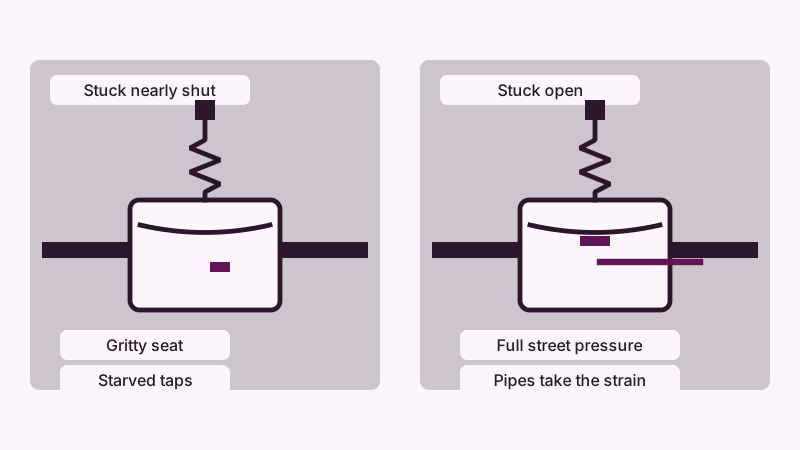
Many tract houses carry one, since street pressure in the area can run high. California's plumbing code (section 608.2) wants a regulator whenever supply tops 80 psi. Clues include a needle wandering between extremes, banging when a tap snaps shut, and the safety valve on the heater dripping. Setting a main regulator is plumber work, as the notes on adjusting a regulator make clear, and swapping one out is a short job for the right person.
Can aging galvanized pipe be the cause?
Very often. Zinc-coated steel rusts from within, and scale grows on the bore like plaque in an artery until a generous pipe behaves like a drinking straw. The slow fade over years, with brown water from the first morning draw, fits this picture.
A lot of homes put up in Torrance, Gardena and Lawndale after the war got galvanized lines, and the city's 2025 report lists around 696 ppm dissolved solids in its wells and 541 ppm in imported water, which is plenty of mineral to deposit. You cannot meaningfully descale a narrowed run, so the cure is new pipe. Have a plumber cut out a short sample, because seeing the narrowed opening settles the question. The job itself is described under galvanized pipe replacement.
Could a hidden leak be eating my pressure?
It can, because water that escapes mid-route never reaches the fixtures at full force. Try the meter test. Stop all water use, note the reading or the small spinning triangle, touch no tap for roughly two hours, then compare readings. If it has moved, water is escaping somewhere.
The EPA's WaterSense program says leaks cost the average household over 9,300 gallons yearly, and it recommends this test. Buried or under-slab leaks sometimes show first as weak pressure, then a soggy lawn strip, a floor that is oddly warm, or a bill that creeps. Meter moving yet nothing wet in sight? Tracing the line is a plumber's task. For a drop that arrives in a single night, read sudden low pressure in the house.
Is weak pressure a danger or just an annoyance?
Mostly the latter. It is a symptom to explain, not a hazard on its own. What lies behind it can matter: a leak soaking framing, a regulator that might swing the other way, or supply trouble that lets unwanted water creep backward into pipes.
The worrying pattern is a sudden drop plus water showing up where it should not: a damp ceiling, a hiss inside a wall, a meter spinning with everything off. Close the main and arrange a visit that day. Gas follows its own rule: a smell means going outside first, then calling SoCalGas on 1-800-427-2200, with 911 reserved for anyone in danger. Add your gauge readings to your note when you use our quote page.
Common questions
Which causes are the most common?
A half-shut valve, a tired regulator, narrowed galvanized pipe or a leak, roughly in that order. A clogged whole-house filter and a problem on the street trail behind. A hose-bib gauge plus a meter test sorts out most cases in about twenty minutes.
How would I spot a regulator on its way out?
Log the gauge over a full day. Pressure that creeps upward overnight, thumping when taps close, or readings that wander far above 80 or below 40 all point at the regulator. Test with all water off too, since a failing seat lets pressure build in a closed system.
What can a homeowner do without a plumber?
Fully open any valve that is part shut, soak aerators and showerheads in vinegar, and fit a fresh filter cartridge. Leave regulators, repipes and buried leak tracing to a plumber. Repiping calls for a permit, and California wants a contractor license from $1,000 upward.
Why did it collapse overnight?
Something changed: a valve got turned, a pipe opened up, the regulator quit or crews touched the street main. Ask a neighbor whether theirs is weak too. If your meter keeps moving with the house quiet, close the main valve and book a visit for the same day.
Do softeners and filters choke the flow?
They can. A saturated cartridge or a softener overdue for service squeezes flow, usually at every tap at once. Open its bypass valve; if pressure jumps back, the filter or softener is the culprit and needs fresh media or a service call.
For the wider picture, start with plumber across Torrance.
Sources used
- Rheem, water heater maintenance (40 to 60 psi)
- U.S. EPA WaterSense, Fix a Leak Week (meter test, household leak figure)
- 2025 California Plumbing Code, section 608.2 excessive water pressure
- Published plumbing guides on low water pressure causes and regulator replacement cost, checked November 2026
- City of Torrance, 2025 annual water quality report
Last updated