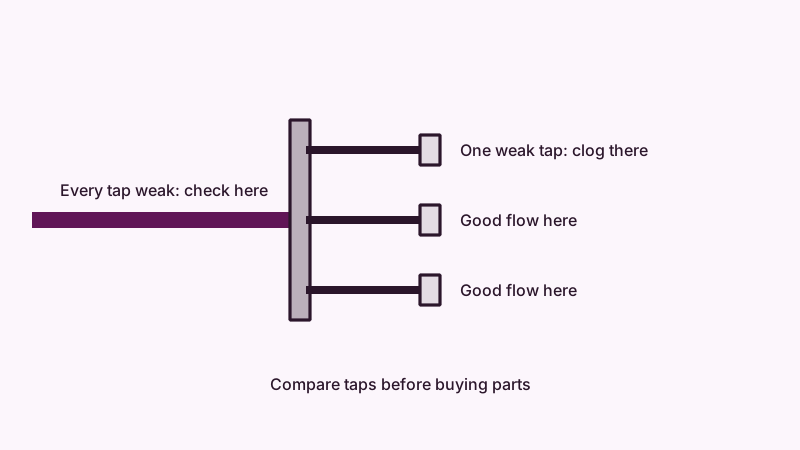
Start by asking one question: is it every tap, or just one? A single weak faucet is almost always a clogged aerator or cartridge. If every fixture is feeble, suspect the supply, a main valve, the regulator, a hidden leak or aging pipe. Related jobs sit on the low water pressure hub, and the steps below take the causes one at a time.
What is my pressure right now?
Thread a test gauge onto a spigot outside, shut every tap indoors, and read the dial. A basic gauge is inexpensive and stocked by hardware stores, and without a number you are guessing. A reading far under normal, or one weak floor in an otherwise fine house, shows where to look next.
Take two readings, one static and one with a shower running. A steep fall under flow means a restriction: scale, a half-shut valve or undersized lines. A low figure with nothing running means trouble upstream, in the supply, a main valve, or a regulator that has drifted.
Log each reading with the hour. Street pressure can dip at busy times, and a pattern tells a plumber or your water supplier plenty. Torrance runs its own municipal water system while neighboring cities use other suppliers, so a drop across a whole street is a call to the supplier.
Is a valve partly closed somewhere?
Often. Examine the house main and the valve near the meter, and open each all the way: a gate valve turns until it stops, a ball valve sits with its handle along the pipe. After plumbing or meter work, a valve left a quarter shut throttles every fixture until someone notices.
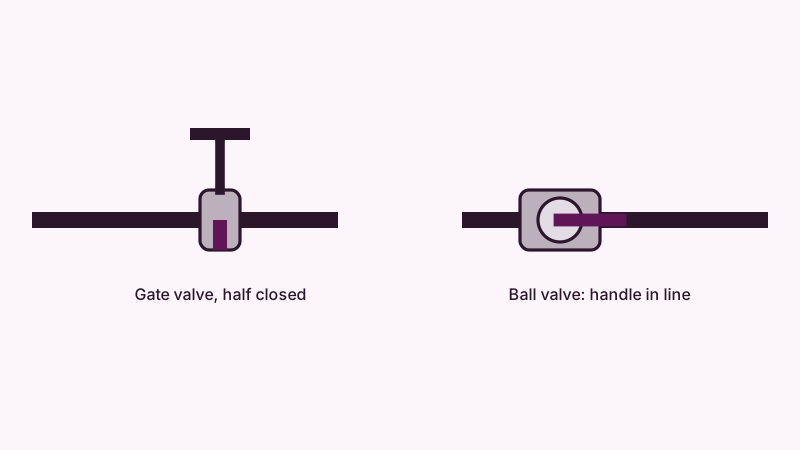
Leave alone any valve belonging to the water system. If the valve is yours, open it slowly. Then check the little stop valves below sinks and behind toilets, sometimes left half shut after repairs. One weak fixture with a half-closed stop is a classic find.
Include the water heater. If only hot water is feeble, look at the valves at the tank. Strong cold with weak hot puts the blame on the heater, its piping or sediment.
Is it just one clogged faucet tip or showerhead?
Possibly, and that is the cheapest cure. Unscrew the aerator from the faucet tip, rinse out grit and mineral flakes, soak it in vinegar if crusted, and refit it. Treat a showerhead the same way. One weak fixture among healthy ones almost always means the fixture itself.
Mineral buildup is common where water is hard. The USGS defines hardness by dissolved calcium and magnesium and notes that very hard water leaves scaly deposits in pipes. The pattern is gradual: a fixture that slowly loses strength over months is scaling up. If every fixture is dropping together, look at supply lines, not the screens. A softener can help in the long run; see water softener installation.
Single-lever cartridges clog too. With a clean aerator and flow still poor, the cartridge is next, and closing the supply valve first keeps the room dry.
Might the regulator be at fault?
It might. A regulator that drifted low, or failed shut, starves every fixture, while one that failed open delivers too much. The gauge decides, and many units adjust with a lock nut and screw. If it cannot hold a setting, or it leaks, replacement is the answer.
With a low gauge reading and a regulator on the line, a plumber can adjust or replace it. The code requires regulation above 80 psi, so a valve sitting at 80 or more needs attention as well. Many houses have no regulator at all.
Be cautious of a quick fix that cranks the screw all the way up. A regulator set too high makes banging pipes and wears fixtures. Aim for a sensible setting and check with the gauge after any adjustment.
Could there be a hidden leak or old pipe behind the problem?
Yes. A leak upstream of the fixtures steals pressure, and old galvanized pipe rusts from within until the bore narrows. Many postwar homes in Torrance, Gardena and Lawndale have galvanized lines that are now choked with rust. With every tap closed, a meter dial that still turns reveals a leak.
EPA says household leaks can waste more than 9,300 gallons a year, and one in the yard or a slab can drag pressure down with no wet spot indoors. Our pages on leaks and leak detection cost explain how hidden leaks are found.
Rusted pipe cannot be cured with a screwdriver. Lasting answers are replacing the worst runs or repiping the house, and the plumber decides from the pipe condition and from where the weakness starts. Written quotes let you weigh a partial job against the full one.
Will a booster pump help, and when is one a good idea?
A booster pump lifts pressure for the whole house, and it suits a supply that is adequate but weak, like a high lot on a hill. It does nothing for a clogged pipe, a closed valve or a supply that cannot deliver enough volume, so deal with those first. Some water suppliers also set rules, so ask before installing one.
A pump needs power, a tank and proper sizing. Put on a line that leaks or clogs, it only pushes more water at the same obstruction. Hillside lots in places such as Rancho Palos Verdes may sit far along a long supply run, and that is where a pump is likelier to pay off.
Save the pump for last. A plumber can weigh it against replacing pipe, since a booster adds cost, noise and upkeep. California wants a contractor license for plumbing beyond a small job size, so use the state board lookup before you hire. To get pricing, submit a quote request with your gauge readings and your earlier attempts. Weekdays, nine to five, is when requests are read. For other jobs, see plumber cost; the Del Amo home page lists our services.
Common questions
Can a pump raise pressure for the whole house?
Yes, a booster pump fitted after the meter does. It has to be sized to the house and installed with a tank, a check valve and wiring, which makes it a plumber's job. It will not cure weak flow from a closed valve, clogged pipe or leak, so find the cause first.
What drops pressure across every tap?
Likely causes: a partly closed main or meter valve, a tired regulator, rusted galvanized pipe, a hidden leak, or a supply problem outside your property. Test with a gauge, check the valves, and ask neighbors. If they share the problem, ring the water supplier.
Which pressure range should I aim for?
Stay at or below 80 psi, the limit past which the code wants a regulator. Plumbers often set houses lower, and the right figure depends on fixtures and pipe. If a shower feels weak, a gauge reading separates a pressure problem from a fixture problem.
Does weak pressure harm the pipes?
Not directly, but it can signal something that does, such as corrosion, a leak or a faulty valve, and it can keep appliances from working well. High pressure is the one that wears fixtures and bangs pipes. Either way, begin with a gauge reading.
Sources used
Last updated