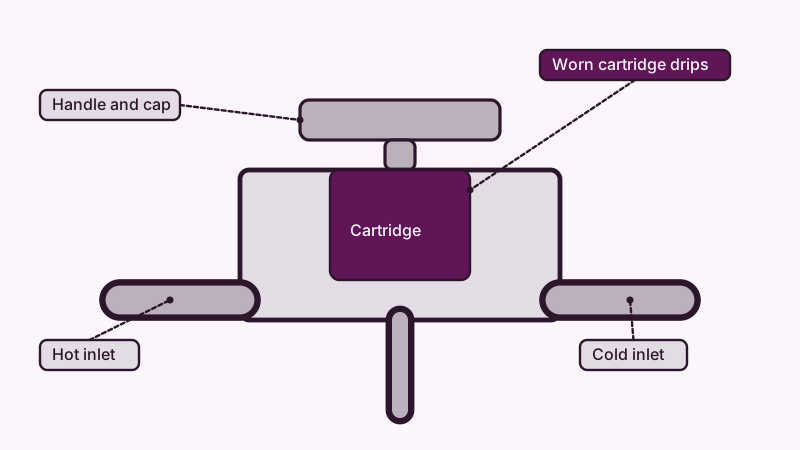
Work out which valve you own before shopping for parts. One handle that pushes and pulls, or turns, almost always holds a cartridge. Two handles, one for hot and one for cold, hold a washer and seat in each. This guide, one of our faucet, sink and shower pages, walks through each type in turn.
Why does my shower faucet keep dripping?
Inside the wall, a valve controls water with a rubber or plastic seal, and that seal wears. When it can no longer close fully, water slips through to the showerhead. Cartridge O-rings harden, washers flatten, and valve seats pit from hard water. The drip is usually constant and comes from the head or the tub spout, and it can mean a worn part or mineral scale inside.
A drip at the handle itself points at an O-ring or packing leak instead. Water running down the wall behind the trim means a leak in the supply pipe, a different matter covered further down. If hot water drips, expect more wear on the hot side from heat.
What is the repair on a one-handle valve?
Cut the supply, strip the handle and cover plate, and withdraw the cartridge, which a clip or nut holds in place. Fit an identical replacement coated in silicone plumber's grease at the O-rings, then rebuild. Plug the tub drain first so small screws cannot vanish. Restore water slowly and try both hot and cold.
Step by step:
- If the shower has stops, close them. Without stops, shut the house supply, and let the shower run empty to release pressure.
- Prise the cap from the handle, loosen the set screw it hides, and pull the handle away.
- Undo the trim plate (the escutcheon) to reveal the valve.
- Take out the clip or nut, and draw the cartridge straight out with pliers or a brand puller. Snap a photo of its position first.
- Match brand, length and splines at a supply counter, then insert the new cartridge facing exactly as the old one did.
Cartridges are brand-specific, so a generic part rarely works. If you cannot identify the brand, a plumbing supply counter can match it from the old one.
And if there are two handles, one hot and one cold?
Each handle drives a compression stem. Take off the handle and trim, unscrew the stem with a wrench, then renew the rubber washer on its end and the O-ring, if there is one. A rough seat inside the valve can be dressed smooth or swapped with a seat wrench. Rebuild and open the stem gradually.
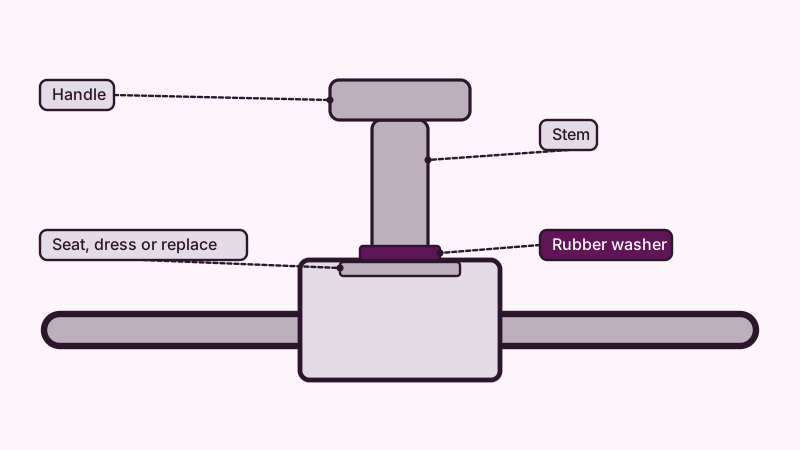
Do one side at a time so you do not mix parts. If the drip persists, the seat is the likely cause. Replacing a seat requires the right wrench and some care, and corroded seats can break. In that case, a plumber with a seat extractor is faster than fighting the part.
What if the drip comes from the shower head or the tub spout?
Drips from the head with the valve closed mean the valve fails to seal, which sends you back to the steps above. A leak where the head threads onto the arm is simpler: unscrew it, wrap new thread-seal tape clockwise around the threads, and screw it back by hand. A tub spout with a diverter that sticks can send water to the head, and replacing the spout often fixes it.
Scale in the nozzles changes the spray without any leak at all. A vinegar soak loosens it, and the method is laid out in clearing hard water deposits. Check which of the spout or head leaks before buying parts.
What does a shower drip cost in water?
More than you would guess. Ten drips a minute from a showerhead comes to over 500 gallons yearly in EPA WaterSense's arithmetic, and the all-leaks average for a household exceeds 9,300 gallons. A shower drip also usually involves hot water, so the water heater runs to cover it, which adds energy cost on top of the water bill.
Fixing the leak is usually cheaper than ignoring it. To put a number on it, see how a dripping faucet shows up on the bill.
When should a plumber open the wall?
Bring one in when you cannot reach the valve, the valve body is corroded, the flow will not stop, or a leak sits behind the wall. A stain on the room next door, a soft floor beside the tub, blistered paint or mold all hint at that. Some showers have no access panel, so reaching the valve means cutting tile or drywall.
An old shower may also deserve a new valve with pressure-balance or thermostatic control, which guards against sudden temperature swings. The valve body can be replaced and the trim matched. Details of such a visit are in shower leak help, and pricing in faucet installation costs.
Common questions
Must the whole house supply be shut?
Only when the shower has no stops of its own, which describes most older South Bay homes. Look for the main valve at the front hose bib or along the garage wall. Confirm the water is truly off by running the shower and the lowest tap before you take anything apart.
Which cartridge is the right one?
Carry the old one to a plumbing supply store. Write down the brand on the trim or valve, the handle style, and the cartridge's length, width and spline count. Photographs help. An exact match matters, since the wrong cartridge may fit but leak, or mix hot and cold backward.
Why did the shower get hotter or colder after the repair?
The cartridge may be rotated the wrong way, which swaps hot and cold, or the temperature limit stop may be set wrong. Most cartridges have a mark or a keyway for orientation. Pull the handle again and rotate the cartridge a quarter turn, comparing the mark with your photo. Test with the water heater set at a safe temperature.
How long is the whole thing?
A cartridge swap runs an hour or less after the part arrives. A tiled wall that has to be opened turns it into a day or more. Want a local plumber? Fill in the quote form and we arrange one.
For the wider picture, start with the plumber guide for Torrance.
Sources used
- EPA WaterSense, Fix a Leak Week
- Faucet and shower valve manufacturer repair instructions (cartridge and washer replacement)
Last updated