A leaking kitchen or bathroom faucet is rarely a reason to buy a new one. Inside the body sits a handful of rubber or ceramic parts that wear, and swapping them is an evening job with a screwdriver and a hex key. Fixtures of this kind are the daily business of our sink fixture and disposal plumbing hub, and what follows is the map from symptom to part.
Which part has failed, judging by where the water shows?
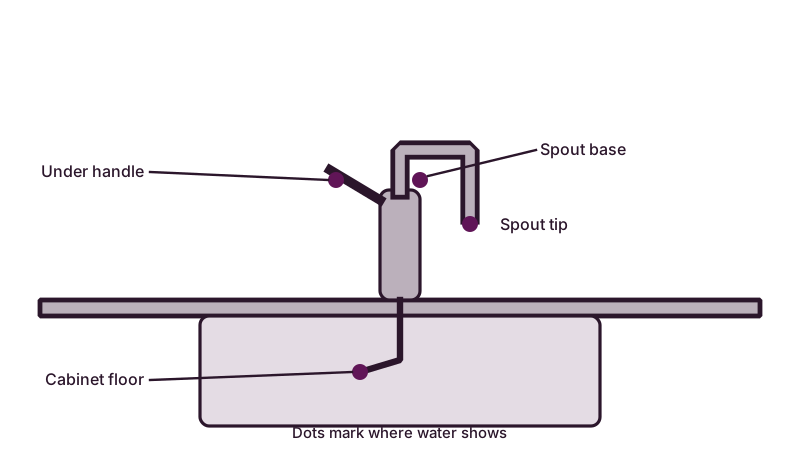
Location is the clue. A bead forming at the end of the spout points inside the valve: cartridge, washer or seat. A damp collar around the foot of the spout points to the rubber rings around the spout stem. Seepage under the handle blames the stem packing. Dampness below the sink, with the faucet dry, blames the supply hoses or stop valves.
Treat this like a lookup table.
| Where it is wet | Usual culprit | What you do |
|---|---|---|
| End of spout, even with handle off | cartridge, rubber washer, pitted seat | renew the cartridge or the washer and seat |
| Ring around the spout base | O-rings on a swiveling spout | roll on new rings, smear with silicone grease |
| Beneath the handle | packing nut or stem O-ring | snug the nut, then renew the ring |
| Spray head or hose | cracked hose, tired washer | new hose or washer |
| Cabinet floor only | supply hose, stop valve, trap nut | dry everything, find the first wet joint |
Dry the sink and the cabinet, press a strip of tissue against each joint, and see which piece darkens first. A wet cabinet fools many people into blaming a faucet that is perfectly dry.
How do I identify my faucet design?
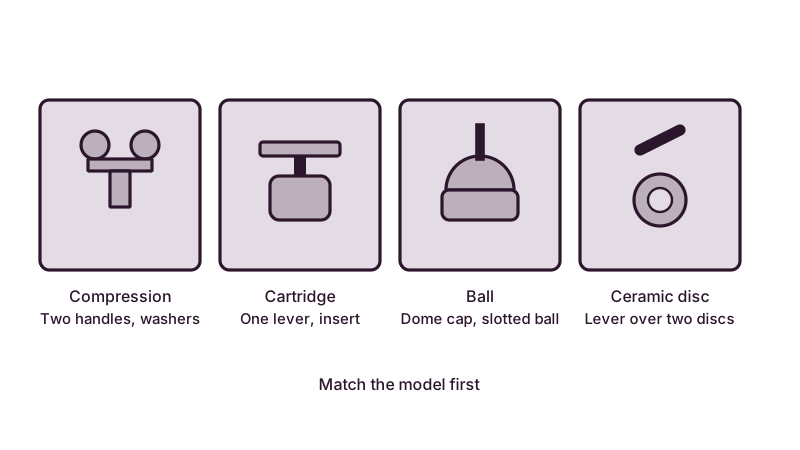
Parts differ by design, so naming yours saves a second trip to the store. Compression faucets have two handles that screw down onto a rubber washer. Cartridge faucets run a single plastic or brass insert. Ball faucets hide a slotted ball under a dome cap. Ceramic disc faucets move two polished discs against each other. Each leaks through a different piece.
Quick identification:
- Two handles that squeeze shut as you turn: compression, so expect washers and seats.
- One lever with a soft, even swing: cartridge or disc.
- One lever sitting on a rounded metal cap with a small adjusting ring: ball.
- A lever plus a spray head on a hose: nearly always a cartridge model, with a small counterweight on the hose.
Brand and model are often printed on the underside of the faucet or on a card that came with it. Failing that, carry the old part to a supply counter for matching by eye, because a lookalike cartridge that sits a millimeter off will never seal.
What is the sequence for renewing a cartridge or washer?
Close both stop valves, let the spout run dry, and stopper the drain. Remove the handle, which is usually held by a screw under a small cap. Unscrew the retaining nut or pull the clip, lift the cartridge straight up, fit its replacement the same way round, grease the new rings, and reassemble. Open the stops slowly and check for drips.
Taken in order, with what to watch for:
- Stops first. Turn the little oval handles under the sink clockwise. If one will not budge, quit. Old stops snap under force, and the house main becomes your only shutoff.
- Drain and plug. Running the spout empties the trapped water. A rag in the drain keeps a dropped screw from vanishing.
- Handle off. Pry the colored button, back out the screw, wiggle the handle free.
- Nut or clip. A large nut under the handle, or a horseshoe clip beside the body, holds the cartridge. Cartridge pullers exist for stubborn ones.
- Look at the seat. Drag a fingernail across the brass ring deep in the bore. Pits or ridges there will chew through a fresh washer within weeks.
- Rebuild. Line up the notches exactly as they sat before, otherwise hot and cold trade places.
- Test. Open the stops slowly and watch the spout for several minutes.
If it drips again, the likely suspects are a damaged seat, a mismatched cartridge, or a body with a hairline crack.
What fixes seepage at the spout base or the handle?
At the spout base, worn rubber rings let water climb past the swivel. Lift the spout, slide off the rings, and replace them with identical ones, lubricated with silicone grease. Under the handle, give the packing nut a small nudge of roughly one quarter turn. Still weeping? The stem seal inside has worn and needs replacing along with the cartridge.
Scale is a frequent accomplice. Cal Water's 2025 report for Hermosa-Redondo gives groundwater an average total hardness around 502 ppm, in what the report calls "very hard" (300 ppm and above), and other South Bay supplies differ. Mineral crust scratches rubber and clogs aerators, so a vinegar soak for stubborn parts is worth the wait.
A leaking pull-out hose is usually at the quick-connect under the sink. Replace its washer, or the whole hose. For nuts dripping on the drain trap, leaks under the sink deals with them separately.
Is a slow drip really worth the trouble?
Yes, for two reasons. By EPA's WaterSense arithmetic, a tap dripping once a second loses upward of 3,000 gallons a year, and the typical household leaks away more than 9,300. The drip also hammers the seat, so waiting turns a few-dollar rubber part into a damaged faucet body.
Whether that shows on your own bill depends on the rate and your use, a topic covered where we discuss drips and water bills. Parts cost little. Hiring someone is where the money goes: national price guides show roughly $150 to $500 for a leaky faucet repair depending on severity, which are national figures and not a Torrance quote.
When does buying a new faucet make more sense?
Buy new when the body is pitted or the finish is flaking, when the maker no longer sells parts, when you have already repaired the same faucet twice, or when the cartridge alone costs more than half a fresh faucet. A hairline crack in the body cannot be fixed. Use the opportunity to renew stops and hoses at the same time.
Kits come with fresh hoses, and swapping onto working stops is a short visit; what plumbers charge is on faucet installation cost. Old homes sometimes have stops that crumble when turned. When one does, close the main valve and let a plumber replace the stops before anything else.
At what stage should I stop and book a plumber?
Stop when a stop will not close, the cracked body has no fix, the leak source stays unclear, water reaches the cabinet floor faster than you can wipe it, or the same repair has failed twice. A plumber can renew the faucet, stops and hoses in one trip. A wider look at the same problem lives in general faucet leak repair.
Describe the leak on the quote page, and expect a written price ahead of any work.
Common questions
What is a realistic time budget?
Set aside thirty to sixty minutes for the swap itself, more if the handle seizes or the store trip is long. A plumber normally needs about an hour for the repair and one to two hours to fit a new faucet.
What should a faucet quote spell out?
It should list the contractor license number, parts and labor separately, the call-out fee and what it covers, and the plan if an old stop valve fails when touched. Ask whether replacing the faucet would cost less than repairing it, and get that comparison on paper.
Does the visit need someone indoors?
Yes. A grown-up lets the plumber in, shows the dripping faucet and the stops, and runs the tap once the job is done. Empty the cabinet beforehand. A relative can stand in for you. Mention pets and alarm codes when booking.
I changed the cartridge and it still drips. Why?
Three likely reasons: the seat in the body is pitted, the new cartridge is not an exact match, or it was not pushed fully home before the nut went on. Check the part number, reseat it, and if the drip returns, the body is probably damaged and replacement is the practical answer.
Is water under the sink always the faucet?
No. A faucet can be bone dry above while a loose supply hose, a weeping stop valve or a drain trap nut soaks the cabinet. Dry every joint, wait, and touch each with tissue. A cracked braided hose needs replacing; a trap nut often needs only a gentle turn.
The rest of our guides start from the plumber guide for Torrance.
Sources used
- U.S. EPA WaterSense, Fix a Leak Week
- Tap (valve), Wikipedia
- National published shower repair price guides, checked November 2026
- Cal Water, 2025 water quality report for Hermosa-Redondo
Last updated