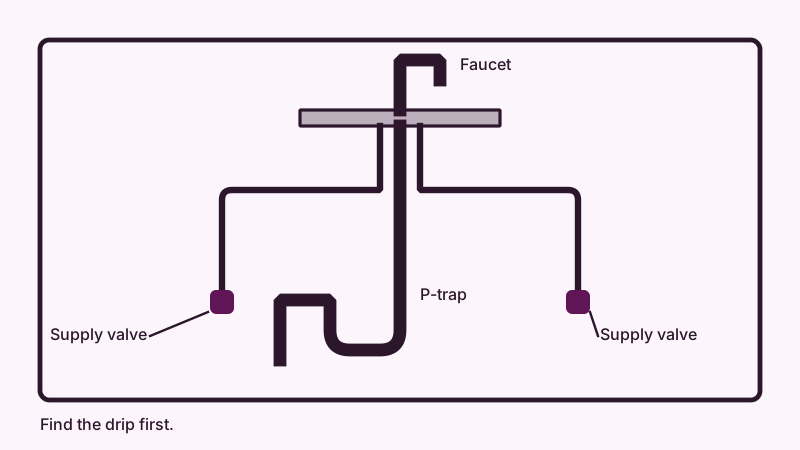
Five parts cause nearly every wet cabinet: the hoses feeding the faucet, the twin shut-off valves, the curved P-trap, the tailpiece under the drain, and whatever connects a disposal or dishwasher. Empty the cabinet, wipe it bone dry and work through the list one by one. Anything involving the disposal itself belongs on our sink and disposal repair help page.
Which part under the sink is the one dripping?
Wipe every pipe dry, lay a strip of paper towel beneath each joint, then use the sink in stages. A drip that appears with the tap on but the basin empty comes from the supply side. A drip that waits until you pull the plug belongs to the waste side.
Work in this order. Open the faucet and look at the hoses and valves. Fill the basin, pull the plug and look at the tailpiece and trap. Last, run the disposal or dishwasher if you have either. Water travels, so a bead on a low joint may have started higher: trace upward to the highest wet spot. A phone torch and a dry rag do better than guessing, and a cleared cabinet stops stored bottles hiding the drip.
Can a sagging, weeping P-trap be fixed by hand?
Put a bucket underneath, back off both slip nuts, inspect the rubber or plastic washers, line the trap up straight, and snug each nut by hand plus about a quarter turn. A cracked trap or flattened washer should be replaced, because cranking harder only splits the plastic.
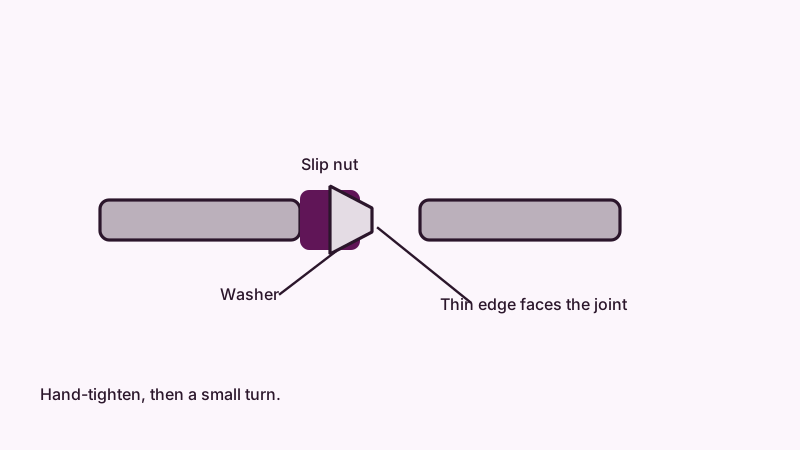
Washers on slip joints are cone-shaped, and the thin edge points toward the joint. Rinse the threads, reseat each piece, then fill the basin and let it run out as the test. A heavy disposal can twist a trap out of line, so eyeball the angle. If it still seeps after a long soak, buy a fresh washer or a whole kit; they are cheap at any hardware counter. If the leak persists beyond that, ask a plumber to check the wall connection.
And if the supply hose or little shut-off valve is the problem?
Replace a hose that drips at either end instead of tightening it over and over. Close the angle valve, crack the faucet open to bleed off pressure, unscrew the old hose and thread on a braided replacement. Valves that seep at the stem, or refuse to close, are for a plumber.
New braided hoses seal with a built-in rubber washer, so hand-tight plus a small wrench turn is enough and tape is unnecessary at those ends. Tapered pipe threads, by contrast, usually take thread tape. Years of sitting still can make an old valve fail the first time it moves. Do not force one that sticks; close the house main instead and call someone. Dampness at the joint between valve and wall pipe gets the same caution.
Is there a quick patch until the proper part arrives?
For a pinhole or a weeping joint on rigid pipe, yes. Two-part epoxy putty, a padded clamp or self-bonding silicone tape can hold for a stretch when the pipe is dry and the line is shut off. Think of it as a bridge, not a cure.
A clamp suits a small hole in tubing. Putty bridges a crack beside a fitting once it hardens. Silicone tape wraps round a pipe, stretching until it bonds with its own layers. None of them rescues a leaking valve stem, and none belongs near gas. If gas ever smells near an appliance in or beside the cabinet, go outside first, and from there dial SoCalGas, 1-800-427-2200. If someone is at risk, 911 comes first.
Might the faucet, not the pipes, be wetting the cabinet?
Yes. Water gathering around the faucet base, or running down the spout, comes from worn seals, a tired cartridge or a loose mounting nut rather than the pipes. Close both angle valves, take the faucet apart, and swap the worn part for the exact match.
A drip at the faucet base can run down the hoses and look like a trap leak. Hard water chews seals faster: Cal Water's 2025 report for Hermosa-Redondo gives its local groundwater an average of about 502 ppm total hardness, though suppliers differ. Scale also clogs aerators. An ancient faucet with no parts on the shelf is better replaced outright. The step-by-step lives in our leaky faucet guide.
What causes disposal and dishwasher leaks under the sink?
Disposals seep from the mounting flange at the sink, from the discharge elbow or through the housing seam. Dishwasher hoses weep at a loose clamp. Tightening cures the first two, but a leak through the body or seam means the unit has worn out.
To locate it, dry the unit, then run water and watch. A drip from the top ring often means the mounting hardware or putty needs redoing. A drip where the dishwasher hose joins is usually a slack clamp. A trickle from the bottom is a dead seal, and replacement is the remedy. Cut the power first, by unplugging or tripping the breaker. The disposal repair guide goes deeper.
Why bother fixing a small drip quickly?
Small drips add up and rot cabinets. EPA figures put the typical home's leakage above 9,300 gallons yearly, and one faucet dripping once a second can lose over 3,000 gallons in a year. Damp particleboard swells, smells and invites mold.
Doubt a drip exists? Try EPA's meter test: note the reading, keep every tap off for two hours, check once more. Movement means a leak somewhere. Peek under every sink while you are at it. EPA also estimates that fixing leaks which are easy to cure can trim a bill by roughly a tenth. Spongy or musty cabinet boards mean the wetness is not new.
When does the job stop being a DIY repair?
Hand it over when a valve will not shut, the pipe is crusted or corroded, the water comes out of a wall or floor, old steel pipe is involved, the cabinet base has rotted, or the same joint leaks again after your repair. Gas and electrical trouble are never do-it-yourself.
California requires a contractor license for jobs of $1,000 or more; check any plumber's through cslb.ca.gov, the state board's license search. If worn steel pipe keeps failing, read about galvanized pipe replacement. Want someone to come out? The quote form starts that, while the home page shows what else is on offer.
Common questions
The cabinet is wet but I see no drip. Where is it coming from?
Slow leaks show only under load, so test each fixture in turn with paper towel under every joint. Cold supply hoses can also sweat in humid weather and mimic a leak. Remember the disposal and dishwasher hose, which release water only when they run.
Can a homeowner mend a leaking P-trap?
Generally. Park a bucket below, unscrew the slip nuts, inspect each washer, line the trap up and retighten finger-tight with one extra quarter turn. If it is cracked or corroded, fit a new trap. When it still weeps afterwards, the drain connection at the wall may be the problem.
Does plumber's tape fix every drip?
No. It belongs on tapered threaded joints only. Slip nuts and compression fittings seal on washers, and wrapping tape there can stop a washer sitting properly. Work out which kind of joint is leaking, then replace the washer or fitting that has aged.
How much is a plumber for an under-sink leak?
No sourced figure exists for this page, so none is printed. Swapping a trap or hose is minor; a dead valve or soaked cabinet base adds labor. After inspecting the damage, the plumber will write a quote, and that written figure is the one to trust.
Should I switch the water off at once?
When it is running rather than dripping, yes. Twist the angle valve beneath the basin, and if that valve is seized use the main at the house. Stay away from wet outlets; cut power at the panel only if the ground in front of it is not wet.
Sources used
Last updated