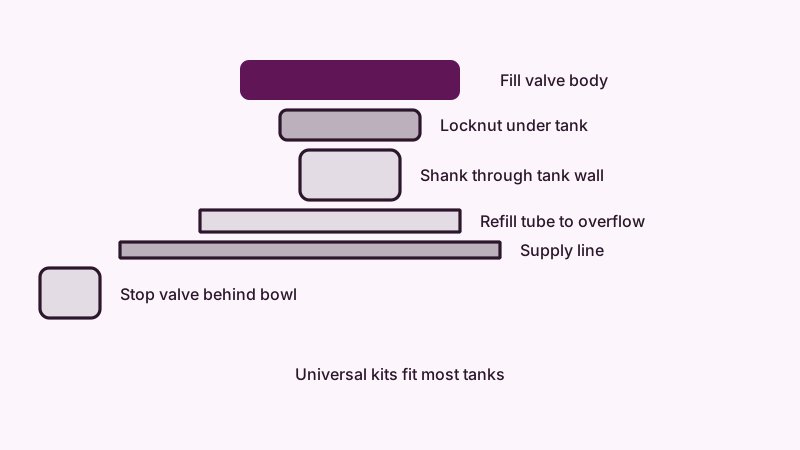
Lift the tank cover after a flush and simply observe. Water that hisses in for minutes, climbs past the overflow tube, or trickles on and off with nobody near the toilet is blaming one of two parts: the fill valve, usually at the left, or the rubber flapper sitting over the drain hole. Both are cheap, and a first-timer can handle either. For the wider fixture, our toilet repair hub is the place to start.
Which part is failing, the valve or the flapper?
Use your eyes and ears. A tank that keeps filling until water spills down the center standpipe, that hisses when full, or that refills at a crawl, implicates the fill valve. A tank that wakes itself up every so often while the level stays low points at the flapper, which lets water creep into the bowl.
EPA's quick check settles doubt. Add a little food dye to the tank, resist flushing for ten minutes, and look for tint in the bowl. If it does, the flapper leaks and the fill valve is merely replacing what escapes. Flush straight after to spare the tank from stains.
| Clue | Usual suspect |
|---|---|
| Water spilling over the overflow tube | Float set too high, or valve that will not close |
| Whistle or hiss when full | Tired seal inside the fill valve |
| Very slow refill | Grit in the valve, or a stop valve only half open |
| Color shows in the bowl | Flapper or flush valve seat |
| Handle has to be held down | Chain, handle arm or flapper |
Can a running toilet really inflate a water bill?
Yes. EPA WaterSense says a leaking toilet can waste as much as 200 gallons a day, and water is billed in units of 748 gallons, so a silent leak can add several units a month. Check the city's current rate schedule for what that costs, before sewer and meter charges. Slow leaks cost less.
Treat 200 gallons as an illustration, since valves fail in different ways. Check your meter if you suspect more. For the city's tiers, see why a water bill climbs. The takeaway is that a cheap part can repay itself within weeks, and the leak makes no noise worth noticing. EPA says household leaks can waste more than 9,300 gallons a year.
How is the fill valve swapped out?
Turn the stop valve behind the bowl clockwise, flush, then mop the tank bottom with a sponge. Unthread the supply line at the valve's base, back off the plastic nut under the tank, and pull the old valve free. Set the new one to the height on its packet, hand-tighten, reconnect, and test before replacing the lid.
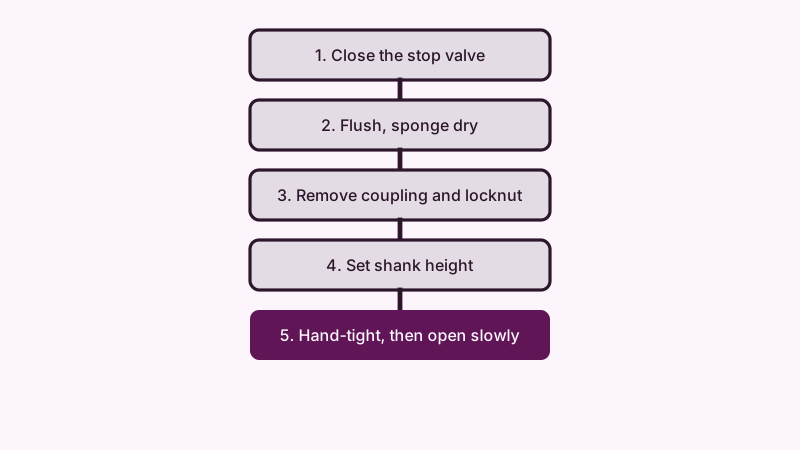
A longer version, in the order that avoids puddles:
- Lay a towel and set a small bucket beneath the connection. Universal kits suit most toilets, so buy one before you start.
- After closing the stop and flushing, sponge the tank dry.
- Spin off the coupling nut that holds the supply line, then the locknut under the tank. A little water will dribble out.
- Pull the old valve out through the top of the tank.
- Extend or shorten the new valve's shank to the height in the packet, then lower it into the same hole.
- Tighten the locknut by hand, then a touch more. Porcelain cracks if you lean on a wrench.
- Attach the supply line, push the thin refill hose onto the clip on the overflow tube, then open the stop slowly.
- Move the float until the water settles about an inch below the overflow rim. Flush three times, then wipe a dry tissue around each joint to catch weeping.
If the stop valve is stiff or weeping, change that first; see toilet repair shut-off valve.
Should the flapper and its seal be replaced too?
Usually, yes, when the flapper is warped, slimy or several years old. It costs a few dollars, takes minutes and removes the most common source of silent leaks. Feel the rim of the flush opening too: a pitted or gritty seat will leak past even a fresh flapper, and then a seal kit or a gasket set makes more sense.
Leave the chain with a little play. Keep the chain from pulling the flapper open, and from drooping so far that it jams beneath. Wipe the seat clean, or rub it lightly with a fine non-metallic pad. Flapper types and sizes and flapper repair cover fit in more detail.
When the tank itself shows cracks, rusted bolts or a tired tank-to-bowl gasket, a new valve will not rescue it, and a new toilet may be better value. Compare costs on toilet replacement.
What if the supply line to the toilet bursts?
The braided or plastic connector between stop valve and tank can split, and when it does the leak is fast. Shut the stop valve straight away, or the main if the stop is jammed, then mop. Fit a fresh line afterward. They cost little, and swapping an old one during any toilet job is sensible.
The first clue is usually a wet floor with no obvious source. Trace it in order: supply line, stop valve, tank bolts, then the wax seal at the base. Water coming from inside the wall instead of the connector is a bigger problem; read the burst water pipe guide.
What does it cost, and when should I hire someone?
A fill valve kit is a small hardware-store purchase, and a plumber's charge is set by the written quote. Call someone if the stop valve is crusty, the tank is cracked, or kneeling on the bathroom floor is not your idea of a good afternoon.
Trip fees often make a small job cost more than the part suggests, so ask whether doing the flapper in the same visit is cheaper. For a deeper look, see labor cost for a fill valve. Prefer someone else do it? The quote page starts that.
Common questions
How long is the job?
Half an hour to three-quarters of one for a first attempt, less once you have done it. The time goes into draining the tank, wrestling with the coupling nut and fine-tuning the water level. A plumber with an accessible toilet usually finishes faster.
Why does my toilet whistle while it fills?
Most often the valve's seal is worn, the stop valve is only partly open, or grit has lodged in the valve. Opening the stop fully can silence it. If the sound persists, replace the valve; cleaning an old one rarely pays when a new one costs so little.
Will I be without water everywhere?
No, the stop valve behind the toilet isolates the fixture. If it refuses to close, or weeps when turned, replace it and lean on the main valve in the meantime. Never force a stiff stop, since a snapped stem can turn a small chore into a flood.
Will a new fill valve cure a weak flush?
Not alone. Weak flushes tend to come from a low water level, blocked rim jets, a partial clog or an over-long chain. A new valve helps only when the tank is not filling to the correct level. For flush trouble, see toilet flush repair.
Is a license needed for this?
Not for fixing your own toilet. Hiring out is different, though a small toilet job rarely reaches the dollar threshold where California requires a contractor license. CSLB's website will still let you look a contractor up, and a price on paper is always reasonable.
For the wider picture, start with Del Amo Plumbing plumber.
Sources used
Last updated