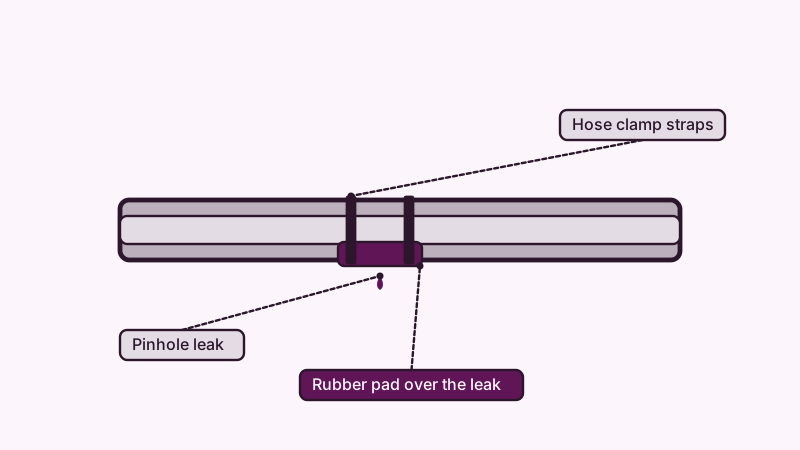
Closing the nearest shut-off, drying the pipe and wrapping the leak with a clamp, putty or self-bonding tape will stop most plastic-pipe leaks for now; a proper repair follows. This guide runs from the first minutes to permanent fixes, and flags jobs that need a professional. Our other Torrance services sit on the home page. Slow drips suit a home repair; a leak in a wall cavity, beneath a slab or on a gas or heating line does not.
What happens in the first few minutes after I spot a leak?
Shut the closest valve, or the house main if none is in sight, then crack open the lowest tap so the line empties. A hot-water pipe means the heater's breaker or gas control goes off too. Slide a towel and bucket under the drip.
Find the main valve before an emergency. In many houses it sits where the line enters the home, often by a front hose bib, and the curb meter box has a valve of its own. When a pipe is spraying and no valve is reachable, the meter-box valve is the fallback, worked with a meter key or big wrench; give up if it will not budge. Lift rugs and electronics clear. Once the pipe has drained, towel it dry, because tape and putty will not grip a damp surface.
Which kind of plastic pipe is leaking?
The type decides the fix. PVC and CPVC are rigid and usually white, cream or gray. PEX is flexible and red, blue or white. ABS is black and rigid and carries drain water. Polybutylene is gray and flexible and has a poor failure record. Identify it before you buy a repair part.
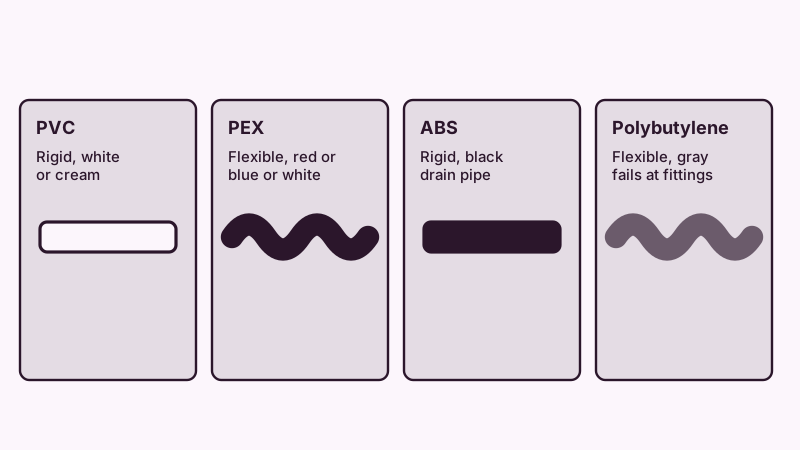
Rigid PVC mostly carries drain and irrigation water, and CPVC serves some indoor hot and cold supply. Newer repipes usually use PEX. ABS and PVC drains only hold water briefly, so their leaks tend to appear at joints during a flush. Wikipedia notes polybutylene went into millions of North American houses from about 1978 until 1997, failing mostly at fittings and bends. Gray flexible supply pipe with plastic fittings is suspect; see polybutylene replacement.
Which stopgap seal survives a few days on a plastic pipe?
On a small pinhole or a weeping joint, a rubber-and-hose-clamp patch, two-component epoxy putty or self-bonding silicone tape can last days or weeks. Press firmly, overlap generously and keep the line depressurized while it cures. Consider it a bridge to a real repair, never the end of the story.
A padded clamp suits a pinhole in rigid pipe. Putty fills small cracks beside a fitting: knead, press in, then respect the label's cure time. Silicone tape stretches over round PEX and PVC and fuses with itself. Duct tape fails. Gas and heating lines are outside what any of these can safely handle, and a gas leak is never a home project. If gas ever smells, get everyone out, and only then, then phone SoCalGas on 1-800-427-2200 from a safe spot, with 911 for any immediate danger.
How do I fix a plastic pipe without replacing it?
A repair coupling is the usual answer. Cut out the damaged inch or two and fit a slip coupling or a push-fit coupling approved for that pipe, or use a repair clamp on a small split. Leaks at a PVC joint can sometimes be sealed without cutting, though a cut-and-replace is tougher.
For rigid PVC, solvent cement makes a permanent weld, but it needs a dry, clean fit and cure time before pressure is restored. For PEX, a crimp, clamp or push-fit fitting on a clean square cut is standard. For CPVC, use a transition or solvent cement made for it. Push-fit couplings suit tight spaces, and you can read details in fixing a leaking PVC joint without cutting. If you are not confident working inside a wall, leaking water pipe repair is a job to hand over.
How do I stop a plastic pipe leaking outside?
Outdoor plastic lines (irrigation, hose-bib feeds, yard runs) usually fail from sun-weakened pipe, cracked fittings or a stray spade. Turn off the sprinkler zone or the house main, dig down to the break, dry it, then fit a coupling. A line wandering under a lawn all night may sit deeper than expected.
Sunlight embrittles exposed PVC over the years, so a pipe baking beside a block wall can crack with no impact at all. Buried leaks reveal themselves as soggy turf, lush green patches or a meter dial drifting round. Try this: shut every tap, then check the meter's little flow dial. EPA says household leaks can waste more than 9,300 gallons a year, reason enough to chase small ones. Before digging deep, ring 811 so buried utility lines are marked.
Why does my tap keep dripping, and can I stop it?
Most dripping taps need a new washer, O-ring or cartridge, not new pipe. Close the supply valve beneath the basin, then pull off the handle and swap the worn part. Water at the spout's foot normally means an O-ring; water at the handle suggests packing or the cartridge.
Compression taps rely on a rubber washer that stiffens over time, while cartridge and ball faucets rely on cartridges or seals bought by brand and model. Carry the worn piece to the shop for an exact match. Hard water speeds wear; Cal Water's 2025 Hermosa-Redondo report puts local groundwater near 502 ppm hardness. Want every step? Our leaky faucet guide has them.
Whose job is the pipe that brings water into the house?
As a rule the supplier maintains pipe as far as the meter. Past that point, ownership shifts to the homeowner. Boundaries differ by supplier, so ask yours. The bill shows which utility serves the address, and a phone call settles any doubt.
A failure inside the meter boundary is yours to pay for, while one out in the road or at the meter body is the supplier's. A meter that keeps spinning with every tap closed, plus a damp spot near the front wall, suggests your side. Water bubbling up in the road should be reported to the utility. Renting? Tell the landlord by letter or email and save the thread.
What is the lifespan of household pipe, and what signals replacement?
It depends on the material. Bob Vila's repipe guide lists copper at 50 to 100 years, PEX at 80 to 100, and CPVC at 50 to 70. Galvanized steel often corrodes from the inside after several decades. Polybutylene is the exception, with failures at fittings, and replacement is the only long-term fix.
Several leaks in different spots, rusty water, dwindling pressure, or original supply lines in a pre-1980s house all argue for a repipe quote over another patch. Postwar tracts in Torrance, Gardena and Lawndale often carry older supply piping, and a second or third failure justifies a conversation. For old steel lines read galvanized pipe replacement; choosing new pipe? Compare PEX versus copper. Whole-house jobs are described under repiping a house.
Which leaks need a plumber, not a patch?
Phone a plumber if the water comes out of a wall cavity or ceiling, the line carries gas or heating water, the stream could scald, the same joint keeps failing, or the shut-off cannot be found. Wet floors near outlets are a safety matter: cut power at the panel solely if you can get there dry.
On the visit, a local plumber holding the state's contractor license traces the source (moisture tools if needed) and writes a quote. Anyone can verify that license through cslb.ca.gov. Pipes that have already split are covered in emergency burst pipe help and the leaks overview. Or start with the quote form.
Common questions
How do I spot a dodgy plumber?
Look the contractor up at cslb.ca.gov, ask for a quote in writing that lists scope and price, and walk away from anyone demanding full payment up front, refusing to put terms on paper, or dodging questions about permits on larger jobs. Vague answers are the usual warning sign.
Where do I find a dependable plumber in Torrance?
Verify any candidate on the state license lookup, compare quotes covering identical scope, and ask who obtains permits and who answers for the work afterward. To have a plumber visit and price the work, send the quote form and describe what you found.
Can a broken pipe be mended without being replaced?
Often, for small splits and pinholes. A repair clamp, slip coupling or push-fit coupling replaces just the damaged inch or two. A split that runs along a long stretch, repeated leaks, or a brittle old pipe usually calls for replacing the whole run instead of another short repair.
How do I stop pipes from bursting?
Keep static pressure below the plumbing code's 80 psi, add a regulator if it runs higher, wrap exposed lines in an unheated garage for the rare cold night, retire brittle old pipe, and learn the main shut-off's position. Around here pressure spikes and tired pipe burst more pipes than frost does.
What is a stopgap for a busted pipe?
Close the closest valve, empty and dry the pipe, then bind the break with a padded clamp or self-bonding tape, or press putty into a crack. Keep the line depressurized while it sets, and book a real repair soon, since patches can let go unannounced.
Sources used
Last updated