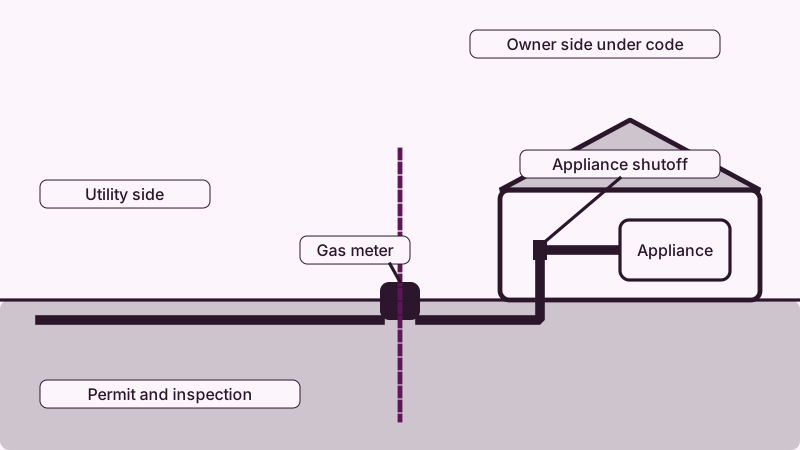
There is no single rulebook a homeowner can read and follow. California adopts a statewide plumbing code, which includes a section on fuel gas piping, cities such as Torrance enforce it through their building division, and SoCalGas sets its own rules at the meter. What that means in practice: gas work needs a contractor, a permit and an inspection. This page explains the pieces. Think of it as a companion to our gas plumber in Torrance page. It explains; the code and the city decide.
Which code governs gas piping in a Torrance house?
Fuel gas piping inside buildings falls under California's plumbing code, one volume of the Title 24 building standards. Cities enforce it, sometimes with their own amendments. In Torrance that means the Building and Safety division. Which edition applies depends on the permit date, so ask Building and Safety, (310) 618-5910, rather than assuming.
The meter is the dividing line. The meter marks the boundary. SoCalGas normally maintains what lies upstream of it, meter included, while code and city oversight cover everything downstream to the appliances. Appliance makers add their own installation rules, such as clearances, venting and connector type, and inspectors check those against the manual that came with the appliance.
No section numbers appear here, because we did not review Torrance's adopted text for this page. The questions below show what the rules cover, in general terms, and where to confirm the detail.
Who pulls the permit for gas pipe work?
Plan on a permit whenever gas pipe is added, lengthened, moved or repaired, filed by the contractor holding the appropriate California license. The City of Torrance lists pipes, fixtures, water heaters and sewer work under its plumbing permit, but its FAQ does not spell out gas piping, so confirm with Building and Safety before you start.
Applications to Torrance Building and Safety are accepted electronically through the city's online system. The city also notes that homeowners can pull owner-builder permits for their own primary residence, though the page does not say that this extends to plumbing or gas permits. Gas is the wrong place to experiment: a homeowner may legally do some work, but a leak or a bad joint carries a risk to the whole building.
California requires a contractor license once a job passes a modest dollar amount, and plumbing falls under classification C-36. Verify the license in the CSLB lookup ahead of the start date, and read the board's consumer pages for the current dollar threshold.
What does a gas piping inspection check?
Inspectors measure the work against the code and the appliance manual. On their list: suitable pipe material and diameter for the load, firm supports, proper fittings, a shutoff near each appliance, suitable connectors, protection for pipe running through walls or floors, venting and combustion air, and the pressure test result. The details come from the adopted code.
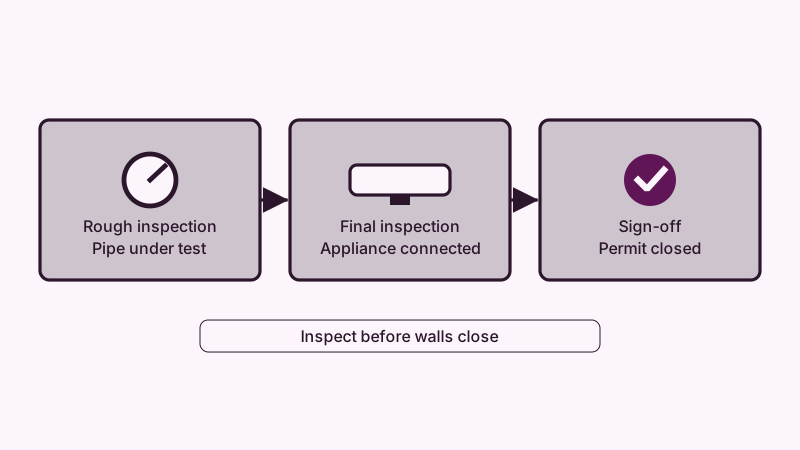
In plain terms, here is what usually happens:
- Rough inspection. Before walls are closed, the inspector sees the piping and may watch a pressure test. The new piping holds a gauge reading for a set period if it is sound.
- Final inspection. The appliance is connected, the shutoff is in place, and the inspector checks the connector, the venting and often a leak check with a gas detector or leak solution.
- Sign-off. Once approved, the permit is closed. Ask for a copy.
If the work is moved, extended or behind finished walls, inspectors usually want to see it before it is covered. That is one reason gas jobs are planned with the wall open. Typical prices sit on the gas line cost page, and the service overview is plumber gas line work.
What pipe materials and connectors are allowed?
Common materials include black steel pipe, galvanized steel, corrugated stainless steel tubing (CSST) with its fittings, and in some cases copper or flexible appliance connectors, but what is allowed depends on the code edition, the gas, the location and the manufacturer's instructions. Do not choose a material by price alone, and do not assume a fitting is allowed because a store sells it.
Points that often matter:
- CSST has its own installation rules from the manufacturer, which can include bonding requirements, and inspectors often look for it.
- Flexible appliance connectors are for connecting an appliance, not for running through walls or floors.
- Older homes may have steel pipe that has corroded or been altered over decades. An inspection or pressure test can show whether it is still sound.
- Underground piping has its own material and protection rules.
Unsure what suits your job? Have the plumber name the material and explain the choice, and confirm with Building and Safety that it is permitted.
What are the rules about shutoff valves, earthquakes and leaks?
Appliances normally carry an individual shutoff valve close at hand, and the whole house can be closed at the meter. SoCalGas wants the meter closed only for a smell, a hiss or other signs of a leak, and reopened only by its own crews, who relight the pilots. Some homes also have an automatic earthquake shutoff valve, which has its own reset steps.
If gas is detectable, get out, then call SoCalGas from a distance on 1-800-427-2200, with 911 too if anyone may be harmed. The utility's advice: touch no switches or appliances, strike no flame, and leave pipe and meter repairs to the experts. For the quake-triggered valve, start with what it is and does and continue to the reset steps.
How do gas piping rules connect to inspection, permits and backflow elsewhere in the house?
They are separate systems with the same kind of oversight. Gas piping is pressure tested and inspected. In Torrance a water heater swap carries its own plumbing permit. Backflow assemblies on the water supply are tested on the water supplier's schedule, which is a different program and a different set of testers.
A project can touch several at once, for example a tankless heater needing larger gas pipe beside a sprinkler device; ask each office what applies. Building and Safety handles permits, SoCalGas handles the meter and service, and your water supplier handles backflow. The water-side program is explained in backflow testing, and the heater paperwork in water heater permits.
Common questions
How long until the job is signed off?
It depends on the city's schedule and the job. A simple appliance line may be permitted quickly and inspected in a visit, while longer runs need rough and final inspections on separate days. Get a schedule from the plumber that names inspection dates, and ask Building and Safety how far out inspections are booked.
Which points should a gas piping quote cover?
Start by verifying the license number on the board's site. Then look for the person pulling the permit, inspection fee treatment, which pipe and fittings go in, whether pressure testing is included and how walls get patched. Have the lot written down before any work begins.
Must an adult be home when the inspector comes?
Usually, yes: an adult gives the inspector access and stands by at the appliance and the meter. The plumber can often be there instead, if you arrange it, but check with Building and Safety. Tell the plumber about pets, gates and any access issues so the inspector is not turned away.
Can I do gas work myself on my own house?
We do not recommend it, and some work is restricted. A bad joint can leak inside a wall, and a homeowner owns the consequences. Even where owner work is allowed, the permit and inspection still apply. Call Building and Safety first, and use a contractor for gas piping. Swapping a hose on a stove is not the same as running new pipe.
Where can I get a gas job quoted?
Request a written quote with the appliance, the distance from the meter, and whether the walls are finished. A local plumber visits, takes measurements and writes a price that covers the permit. We do not quote code sections on this page, so the plumber should state which code requirements apply to your job.
This guide is one of many on Torrance plumber.
Sources used
Last updated